
Jeep · Known Issues
1994-2026 Jeep Wrangler Problems: 73 Known Issues
1994-2026 model years · 2,740+ owner reports · Updated October 2026
All years · All trims · All engines
Choose the year and equipment for your written issues and visual request.
1994-2026 model years · 2,740+ owner reports · Updated October 2026
All years · All trims · All engines
Choose the year and equipment for your written issues and visual request.
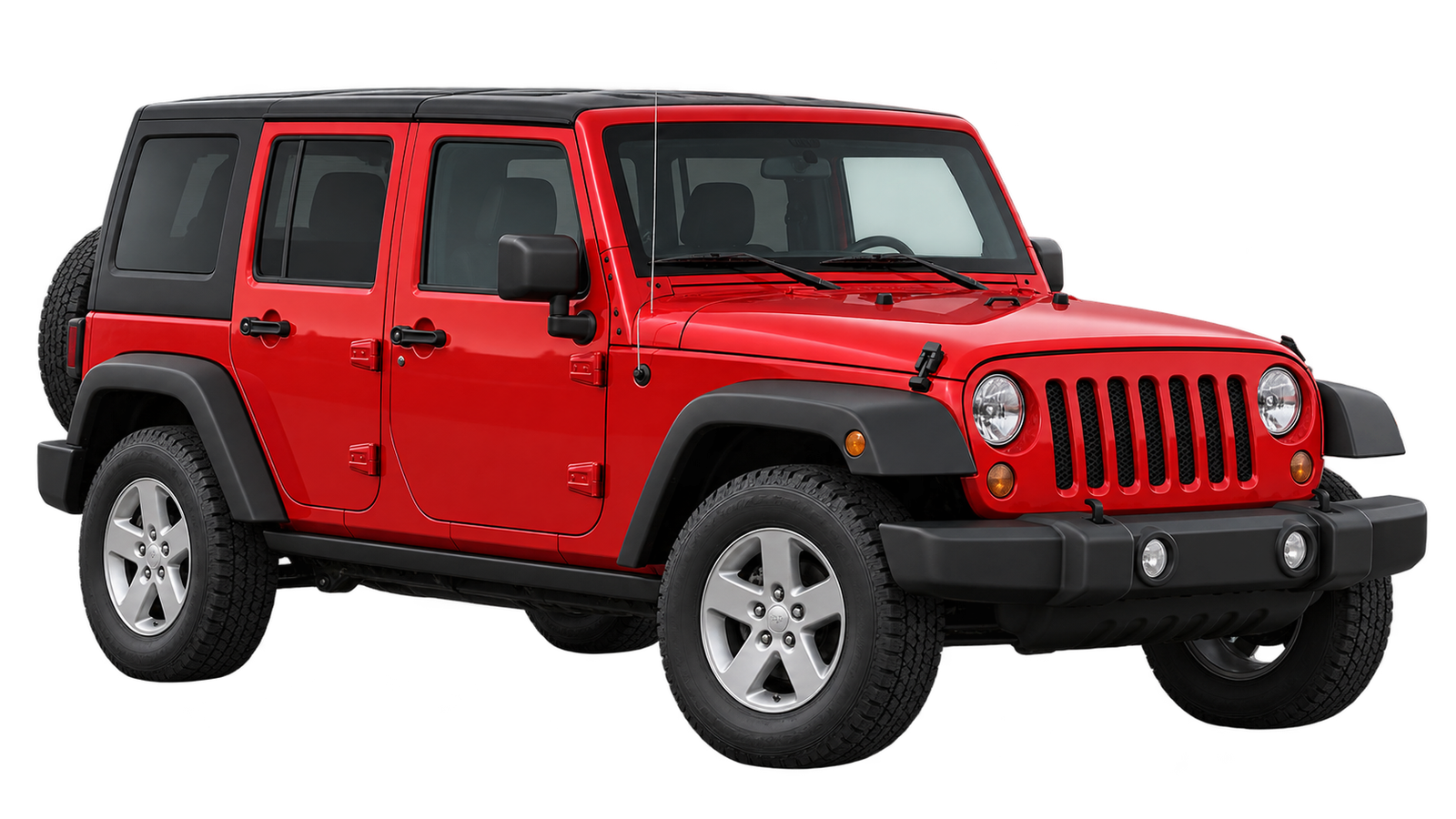
According to Au7o's analysis of 2,740+ owner reports, the 1994-2026 Jeep Wrangler has 73 documented known issues, with 31 rated critical. The most serious are 4xe Engine Sand-Casting Contamination — Loss of Propulsion / Engine Fire (Recall 25V-766 / 78C), Manual transmission clutch pressure plate overheating / fire risk (recall 21V-028 & 23V-116), 4.0L Crankshaft Position Sensor Thermal Failure — Random Stalling & Hot No-Start ($60-$250 repair), October 2025 Uconnect OTA Update Bricks Hybrid Control Processor — Sudden Loss of Drive Power (Recall 25V710 / A7C) ($0-$0 repair), Insufficient Child-Seat Tether Anchor Welds on the Second-Row Right-Side Seat Frame (Recall 26V224 / 27D) ($0-$0 repair), Front-End 'Death Wobble' — Violent Steering Oscillation at Highway Speed After a Bump or Bridge Joint ($150-$900 repair), Steel Wheel Walls Too Thin — Wheels Can Crack or Detach (Recall 26V456 / 05D) ($0-$0 repair), Electric-Hydraulic Power Steering Pump Wiring Overheat — Fire Risk & Loss of Assist (2026 Recall), Clock Spring Failure Causing Airbag Light, Horn, and Cruise Control Loss ($250-$700 repair), In-Tank Fuel Pump Module Failure — Whine, Hard Start & No-Start ($200-$550 repair), Cruise Control May Not Disengage — Wiring Short Circuit (Recall 18V332000), "Death wobble": violent front-end shaking after a bump (owner reports), Front Frame Rust and Control Arm Bracket Corrosion.
An over-the-air Uconnect update pushed on Friday, October 10, 2025 caused an incomplete communication handshake between the Telematics Box Module (TBM) and the Hybrid Control Processor (HCP). The HCP resets, and the vehicle loses all motive power — gasoline and electric — with no warning. NHTSA received well over 100 complaints in the two weeks following the update, nearly all filed in October 2025. Owners describe driving normally for 2-10 minutes, then all dash lights flashing, a 'Shift into PARK to restart' message, complete loss of throttle, and in many cases loss of power steering and brake assist while rolling. Restarting restores operation for a few more minutes before it repeats. Several owners were stranded in traffic or on highways; some reported code P1E1D. Stellantis cancelled the update and pushed an automatic rollback the following evening, then filed a formal safety recall on October 17, 2025 covering 24,238 units of 2023-2025 Wrangler 4xe.
Recall 25V710 (FCA code A7C) covers 24,238 2023-2025 Wrangler 4xe that received the suspect over-the-air software. FCA says an interim fix to avoid the loss of motive power was applied through a backend policy update; the final remedy will be a free telematics box module software update at the dealer, but as of FCA's June 16, 2026 report the final owner letter had not been mailed. Sign up at recalls.mopar.com or call 1-800-853-1403 to be notified when the remedy is available. If the vehicle is in the fault state, Stellantis' interim guidance was to park with the ignition on for at least 10 minutes in an area with cellular coverage so the rollback OTA can install, then key-cycle and check for stored faults. A vehicle that will not clear must be towed; do not attempt to drive it, because the failure removes propulsion, steering assist and brake assist simultaneously.
The 2018 Jeep Wrangler is included in FCA US recall 18V332000, which covers a defect that can prevent the cruise control system from shutting off. NHTSA's record states that if a short circuit occurs in the vehicle's wiring while cruise control is engaged, the driver may not be able to cancel it — neither by pressing the brake pedal nor by switching the system off manually. The Wrangler would then hold its set speed, or possibly accelerate, despite the driver's attempts to deactivate it. NHTSA's stated consequence is an increased risk of a crash. Because 2018 was the only Wrangler model year named in this campaign, owners of a JL or a final-year JK from that year should check their VIN rather than assume the truck is clear.
The repair is free at any Jeep dealer. The dealer inspects the software and performs a software flash on the engine or powertrain control module. Owner notification began June 4, 2018; FCA customer service is 1-800-853-1403. Enter your VIN at nhtsa.gov/recalls to confirm whether your Wrangler is covered and whether the flash was ever performed. Until the update is done, NHTSA advises not using cruise control at all. If cruise control ever will not disengage while driving, apply the brakes firmly and steadily, shift the transmission to neutral, and put the vehicle in park once it has stopped.
JK owners report the fuse and relay module (TIPM) causing electrical faults on its own: dash lights coming on, washers spraying, wipers, horn and turn signals operating, the engine running after the key is off or dying when the wipers are switched on. One owner reports the faults returned a few months after a new replacement module was fitted. Applies to: 2007-2018 Jeep Wrangler and Wrangler Unlimited (JK), all engines.
Note which functions misbehave and when, and have a technician test the TIPM and its connectors and grounds before replacing it. Owners report a replacement TIPM must match the Jeep's VIN and options, and one owner suggests the clockspring or the wiper control module can cause similar wiper faults.
Call to confirm they can assess your vehicle and perform the stated work. Search results do not confirm qualification, eligibility or coverage.
Wrangler 4xe owners report repeated dead 12V auxiliary batteries and, in some cases, complete electrical shutdowns. Several owners found the included Level 1 charger drains the 12V battery after the high-voltage pack reaches 100%, leaving the vehicle unresponsive within days. Beyond no-starts, some 4xe vehicles abruptly lose power or shut off while driving (often when EV range is exhausted), and owners have had to disconnect and reconnect the 12V battery to revive the vehicle, sometimes with persistent warning lights afterward. Dealers frequently cannot locate the parasitic drain even when the 12V battery tests good.
Apply all available 4xe software/PCU updates (some shutdown reports trace to OTA update regressions, and updates have also addressed charging-state drain). Test the 12V auxiliary battery and charging system; replace a weak 12V battery and verify proper terminal connections. As an interim measure many owners unplug the Level 1 charger once the pack reaches 100% to stop the drain. For drive-cycle shutdowns/loss of propulsion, have the dealer pull stored faults and check for related recalls/customer-satisfaction campaigns, as some 4xe loss-of-power conditions overlap with open safety actions.
Call to confirm they can assess your vehicle and perform the stated work. Search results do not confirm qualification, eligibility or coverage.
Chrysler recalled 320,068 vehicles — including all 2020-2025 Wrangler 4xe — because the high-voltage traction battery can fail internally and start a fire whether the vehicle is parked or being driven. This is a separate campaign from the 4xe engine sand-casting-contamination recall; here the defect is inside the HV pack itself. Owners were told to park outside away from structures and to stop charging entirely until remedied, and for months after the December 17, 2025 notification letters no final remedy existed. NHTSA complaints from 2025 Wrangler 4xe owners document the practical consequences: vehicles that cannot be garaged or charged, dealers refusing to open STAR cases, and at least one 2025 Wrangler that caught fire at the passenger front wheel area after a sudden loss of power on the interstate with a family aboard.
Until the recall is completed, follow Stellantis' instructions literally: park outdoors and away from buildings, and do not plug the vehicle in to charge. Have the dealer perform Recall 25V741 (FCA 68C) — high-voltage battery software update with HV battery replacement as necessary, free of charge. Ask the dealer to document the pack's State of Health reading from the diagnostic session; several owners report dealers declining to share it. If the dealer refuses to open a STAR case, escalate through Jeep Wave and file with NHTSA.
Call to confirm they can assess your vehicle and perform the stated work. Search results do not confirm qualification, eligibility or coverage.
Chrysler recalled 32,863 vehicles — 2018-2024 Wrangler and 2020-2024 Gladiator — because the instrument panel cluster can develop an internal short circuit and fail outright, taking the speedometer, fuel gauge, and every telltale and warning lamp with it. NHTSA classified this as a failure to comply with FMVSS 101, 'Controls and Displays.' Unlike a software-blanking fault this is a hardware defect inside the cluster, and the declared remedy is replacement, not a reflash. Owner notification letters went out between October 3, 2024 and January 23, 2025.
Have the dealer perform Recall 24V652 (FCA 30B) — full instrument panel cluster replacement, free of charge. There is no software fix; a dealer offering only a reflash has not performed the campaign. Verify eligibility by VIN at NHTSA.gov before scheduling, and if the cluster has already been replaced at owner expense, submit the receipt to Chrysler customer service (1-800-853-1403) for reimbursement under the recall.
Call to confirm they can assess your vehicle and perform the stated work. Search results do not confirm qualification, eligibility or coverage.
Wrangler models built for the 2017 and 2018 model years are included in FCA US safety recall 18V524000 (Chrysler campaign number U87). The powertrain control module in these Jeeps may contain a circuit-board voltage regulator chip that can fail. When that chip fails, the Wrangler can stall while being driven or refuse to start at all. NHTSA classifies the defect under electrical system wiring, front underhood, and warns that a vehicle stall increases the risk of a crash. The campaign spans a large slice of the FCA lineup for those years, but each affected vehicle is covered individually by VIN.
The repair is free at any Jeep dealer: the dealer replaces the powertrain control module. Chrysler began mailing owner notifications on October 2, 2018, so a used Wrangler may have changed hands without the letter reaching the current owner. Enter your VIN at nhtsa.gov/recalls to confirm whether campaign U87 is still open on your truck, then book the PCM replacement. Chrysler customer service can be reached at 1-800-853-1403.
NHTSA campaign 23V787000 covers certain 2021-2023 Jeep Wrangler plug-in hybrid vehicles whose high-voltage battery may fail internally and cause a fire while parked or driving. That campaign was replaced by 24V720000, which was then replaced by current campaign 25V741000. Vehicles previously repaired under the earlier campaigns may need the current remedy.
Check the VIN for current campaign 25V741000 (FCA recall 68C). Until the current remedy is completed, park outside and away from structures and other vehicles and do not charge the vehicle. Dealers update the high-voltage battery software and replace the battery as necessary, free of charge.
eTorque (mild-hybrid) Wranglers replace the conventional alternator/starter with a 48V belt-driven motor-generator (BSG/MGU) plus a 48V power pack unit (PPU) and a 12V system. Owners report charging-system failures, battery warning lights, rough/failed auto-starts during stop-start cycling, voltage drops, stalling, and no-starts. The most common culprit is the 48V PPU rather than the MGU itself, though both fail. The MGU/BSG (Mopar 68452771AF) is expensive and, once replaced, must be programmed with the dealer scan tool or it will not function. Components fall under the 8-year/80k-mile hybrid warranty, but out-of-warranty repairs are costly.
Diagnose the 48V/12V charging system with the dealer scan tool to distinguish a failed 48V PPU (the most frequent cause) from a failed belt-starter generator (MGU). Replace the PPU or the MGU (Mopar 68452771AF) as indicated; a new MGU MUST be programmed/initialized with the factory tool before it will operate. Inspect the dedicated BSG belt/tensioner (PN 05281667AC) and 12V battery health, since a weak 12V battery can mimic charging faults. Use the hybrid warranty where eligible.
Only diagnosis- and fitment-reviewed repair parts are linked here.
Replace a professionally diagnosed failed 48V PPU after warranty and VIN checks Fitment/availability: Cataloged 2018-2024 Wrangler eTorque applications; VIN confirmation required.
Replace a factory-scan-confirmed failed early 2.0L eTorque generator Fitment/availability: 2019-2020 Wrangler JL with 2.0L eTorque as explicitly cataloged; not a later non-eTorque 2.0L and not the 3.6L MGU. Requires factory initializatio…
Replace a factory-scan-confirmed failed 3.6L eTorque MGU Fitment/availability: Retail fitment explicitly lists 2022-2023 Wrangler 3.6L MHEV; confirm VIN/supersession for any other year.
Replace a cracked, contaminated or out-of-spec BSG drive belt on the compatible 2.0L branch Fitment/availability: 2019 Wrangler JL 2.0L eTorque catalog page; broader early-JL use must be confirmed by VIN.
Replace a confirmed failed lower BSG tensioner on the compatible 2.0L branch Fitment/availability: 2018-2026 Wrangler JL 2.0L with Belt-Start Generator per retailer; verify VIN and actual eTorque configuration.
Replace a cracked, contaminated or out-of-spec MGU drive belt on the compatible 3.6L branch Fitment/availability: 2019-2023 Wrangler JL 3.6L ERG eTorque according to the live listing; confirm VIN/build because the issue's broad 2018-2024…
As an Amazon Associate, we earn from qualifying purchases; other part links may also earn au7o a commission. Confirm fitment by VIN before buying.
The 8.4-inch Uconnect 4 and the newer Uconnect 5 head units frequently freeze, glitch, reboot multiple times before booting, or go to a black screen. A common and safety-relevant failure mode is the rear backup camera failing to display when shifted into Reverse, showing a blue/black screen, or staying on after moving forward. The system is sensitive to 12V voltage drops (a weak auxiliary/aux battery makes it lag, reset, or refuse to boot), and many JLs ship with loose fuses that aggravate the problem. Stellantis acknowledged a broad list of Uconnect 5 failures across 2021-2024 vehicles in Technical Service Bulletin 08-008-24.
Reboot the head unit (hold volume + tuner knobs ~10-20 seconds) and reseat fuse F97 to clear a frozen state. Apply the latest Uconnect software update per TSB 08-008-24, which addresses many freeze/reboot and camera bugs. Check and tighten loose cabin fuses and verify the auxiliary/12V battery health, since low voltage triggers resets. If the backup camera still blanks, inspect the camera, its harness, and connector; replace the camera or radio module if a hardware fault is confirmed.
Only diagnosis- and fitment-reviewed repair parts are linked here.
Do not assume fitment for eTorque or 4xe; en
Replace a circuit-tested failed rear camera after software, power, connector and harness faults are excluded Fitment/availability: 2018-2024 Wrangler JL applications cataloged without the alternate 35-inch-tire or off-road-camera configu…
As an Amazon Associate, we earn from qualifying purchases; other part links may also earn au7o a commission. Confirm fitment by VIN before buying.
The 8.4-inch Uconnect touchscreen suffers physical delamination: the optically-clear adhesive (OCA) bonding the glass digitizer to the display breaks down under repeated dashboard heat cycling. This produces bubbles and cloudy patches, then 'ghost touches' where the screen registers phantom presses (jumping menus, dialing on its own, changing climate), and in severe cases the liquefied adhesive drips onto the center console. This is mechanically distinct from the already-documented Uconnect freeze/reboot software faults. Coverage tightened in December 2024 to a strict 60,000-mile cutoff, leaving many owners paying out of pocket.
Early on, request a Mopar/Jeep Cares goodwill radio replacement if within the 60k-mile/coverage window. The durable fix is to replace or rebuild the touchscreen/digitizer assembly. Many owners use specialist refurb services that remove the failed OCA between the digitizer and LCD and re-bond it (or convert to perimeter tape), at far lower cost than a dealer head-unit swap. Park in shade / use a sunshade to slow heat-driven recurrence.
Only diagnosis- and fitment-reviewed repair parts are linked here.
Replace a physically delaminated compatible LCD/digitizer assembly instead of the complete radio Fitment/availability: 2018-2021 Wrangler JL with Uconnect 4/4C 8.4-inch UAQ or UAS radio using the single-ribbon LA084X01 screen family; con…
As an Amazon Associate, we earn from qualifying purchases; other part links may also earn au7o a commission. Confirm fitment by VIN before buying.
Early JK Wranglers commonly develop instrument-cluster faults: speedometer, tach, fuel, and temp needles that stick, read erratically, or drop to zero, and in some cases full cluster/CCN module failure. Owners report needles losing their retaining adhesive on the stepper-motor shafts. A high-demand JK electrical search.
For sticking/erratic needles, the cluster is removed and the stepper motors/needles reseated or the board repaired; specialists (e.g. UpFix) offer a rebuild-and-return service. Complete failures require a replacement cluster (must be programmed/mileage-matched to the VIN via a dealer or locksmith tool). Reseat any needle fully onto its driver shaft.
Call to confirm they can assess your vehicle and perform the stated work. Search results do not confirm qualification, eligibility or coverage.
Only diagnosis- and fitment-reviewed repair parts are linked here.
Repair and return the original cluster after vehicle-side diagnosis confirms an internal cluster fault Fitment/availability: 2007-2010 Wrangler JK within this issue; service page covers 2007-2018 JK. Confirm covered symptoms, turnaround,…
As an Amazon Associate, we earn from qualifying purchases; other part links may also earn au7o a commission. Confirm fitment by VIN before buying.
The automatic engine start-stop system can be problematic, with complaints about delayed restarts, aggressive shutoffs, and system deactivating in conditions where owners expect it to work. The system defaults to ON each time the vehicle starts.
System can be disabled with button press each drive. Aftermarket ESS disable devices available that remember your preference. Ensure battery is in good condition - weak batteries cause issues. Some owners have had battery replaced to improve ESS function.
Only diagnosis- and fitment-reviewed repair parts are linked here.
Optional reversible device that remembers the driver's ESS-button preference on a healthy system Fitment/availability: 2018-2026 Wrangler JL with non-hybrid gasoline or diesel engine and factory ESS button; explicitly not for 4xe.
As an Amazon Associate, we earn from qualifying purchases; other part links may also earn au7o a commission. Confirm fitment by VIN before buying.
TJ Wranglers commonly lose one or more cabin fan speeds because the blower motor resistor overheats or the connector melts. Owners usually notice the fan only works on high speed, or stops working on lower settings first. The issue is well documented in owner forums and service parts databases, especially on vehicles with aging blower motors that draw excess current.
Diagnosis is straightforward: verify which fan speeds work, inspect the resistor pack and harness for heat damage, and measure blower motor current draw. Replacing only the resistor may be temporary if the blower motor is dragging, so many repairs include both the resistor and pigtail connector. Cleaning cowl drains and checking for moisture intrusion can also help prevent repeat failures.
Only diagnosis- and fitment-reviewed repair parts are linked here.
Restore missing lower fan speeds after circuit testing confirms the early/RHD resistor is open Fitment/availability: 2000-2001 Wrangler TJ LHD or RHD, plus 2002-2006 TJ RHD.
Restore missing lower fan speeds after circuit testing confirms the redesigned LHD resistor is open Fitment/availability: 2002-2006 Wrangler TJ/Unlimited LHD branch; verify steering position and connector.
Connector/harness repair when inspection finds heat damage, loosened terminals or melted plastic Fitment/availability: 1997-2006 Wrangler TJ/LJ application; use only when the connector is damaged and splice with the specified sealed meth…
Verify the supplied resistor geometry against LHD/RHD and model-year split before installatio
As an Amazon Associate, we earn from qualifying purchases; other part links may also earn au7o a commission. Confirm fitment by VIN before buying.
JK owners with power windows report windows that stop working, either all at once until the engine is restarted or one window whose motor runs one way only. Owners suspect the switch, a connector disturbed by door removal, or the window motor or regulator; the cause was not confirmed in these reports. Applies to: Only Jeep Wrangler and Wrangler Unlimited (JK) with power windows. Owner reports name 2010 and 2011 JKs.
Note whether one window or all windows stop. Owners suggest checking the door connectors first, especially if the doors have been off, then the switch; a window that runs one way only or a motor that hums without moving the glass points to the motor or regulator. Have a technician confirm before buying parts.
Call to confirm they can assess your vehicle and perform the stated work. Search results do not confirm qualification, eligibility or coverage.
NHTSA campaign 25V766000 covers certain 2024-2025 Jeep Wrangler 4xe plug-in hybrid vehicles. Casting-sand debris inside the engine can contaminate internal components and cause catastrophic engine failure, an unexpected loss of drive power, or an engine-compartment fire. Owners may notice engine knocking or a malfunction indicator lamp before failure.
Check the VIN for campaign 25V766000 (FCA recall 78C). Dealers install a software update and replace the engine block or engine as necessary, free of charge. Stop driving and contact a dealer if knocking, a malfunction indicator lamp, loss of propulsion, smoke, or fire occurs.
Call to confirm they can assess your vehicle and perform the stated work. Search results do not confirm qualification, eligibility or coverage.
The crankshaft position sensor (CPS) on the 4.0L (and 2.5L) inline engines mounts on the transmission bellhousing and is exposed to severe heat soak. As it ages it develops intermittent thermal failure: the engine stalls without warning once hot, then refuses to restart until it cools, after which it runs fine again — a maddening, hard-to-replicate fault. Frequently the CPS fails with NO check-engine light and NO stored code, so it is commonly misdiagnosed. It is a top-searched TJ/early-Wrangler stalling complaint and a roadside-safety concern because the stall is sudden.
When the engine stalls hot and won't restart, unplugging and reconnecting the CPS connector (near the back of the intake) often resets the PCM and the engine fires — a strong indicator the CPS is failing. Replace the crankshaft position sensor with a Mopar or NTK/NGK unit (Mopar 56027866AE for many 4.0L applications; 4727451AA covers 2003-2011 TJ/JK 3.8L & 4.0L). Avoid bargain aftermarket sensors — out-of-tolerance units cause repeat no-starts. No relearn required; verify with a hot road test.
Only diagnosis- and fitment-reviewed repair parts are linked here.
Manual-transmission/early-engine sensor replacement after hot testing confirms signal dropout Fitment/availability: 1997-2004 Wrangler TJ 4.0L manual-transmission branch; the underlying application family also covers specified 1997-2002 …
Early automatic-transmission sensor replacement after hot testing confirms signal dropout Fitment/availability: 1997-2002 Wrangler TJ 4.0L automatic-transmission branch. Confirm connector and transmission; not the manual or 2003-2006 bra…
Later TJ 4.0L sensor replacement after hot testing confirms crank-signal dropout Fitment/availability: Crosses Mopar 4727451AA for specified 2003-2006 Wrangler TJ 4.0L applications; verify transmission/connector and exact catalog fit bef…
As an Amazon Associate, we earn from qualifying purchases; other part links may also earn au7o a commission. Confirm fitment by VIN before buying.
On select 2012-2013 Wranglers with the 3.6L engine (sales code ERB), the left cylinder head can develop valve guide and valve seat wear, setting misfire codes P0300, P0302, P0304 or P0306 and turning on the check-engine light. FCA extended coverage on the left cylinder head to 10 years or 150,000 miles from the in-service date under program X56; that period has now ended on most or all of these Jeeps. Applies to: 2012 and select 2013 Jeep Wrangler (JK) with the 3.6L Pentastar V6 (ERB).
Service bulletin 09-002-14 REV. B has the technician run a cylinder leakage test on cylinders 2, 4 and 6 and replace the left cylinder head if any shows 25% leakage or more; otherwise normal diagnosis applies. The X56 extension ran 10 years or 150,000 miles from the in-service date, so it has now expired on most or all of these Jeeps; a dealer can confirm from the VIN.
Owners of 3.6L JK Wranglers report a persistent ticking from the top of the engine; dealers replaced rocker arms and lifters to cure it. Owners report that leaving it alone let a damaged rocker grind the camshaft lobe, turning a small repair into a camshaft replacement, and one owner reports the engine eventually lost compression. Applies to: 2012-2018 Jeep Wrangler and Wrangler Unlimited (JK) with the 3.6L Pentastar V6. Owner reports name 2014 and 2015 JKs. Mileage when it happened, as stated in the linked owner reports: 35,000 miles on a 2014 and 167,500 miles on a 2014.
Have a new or worsening tick checked promptly rather than waiting for a check-engine light. Owners report technicians removing the valve cover to inspect the rocker arms, lifters and camshaft lobes, and replacing worn rockers and lifters, plus the camshaft if a lobe is damaged. Have a technician confirm the source, because other parts can also tick.
Call to confirm they can assess your vehicle and perform the stated work. Search results do not confirm qualification, eligibility or coverage.
The 4.0L inline-six heads carrying casting number 0331 (used on roughly 1999-2002 builds) were designed with enlarged intake/exhaust ports but left the deck wall between cylinders #3 and #4 too thin. Over high-mileage thermal cycling the head cracks in that area (visible through the oil-filler cap between the #3/#4 valve springs), often letting coolant weep into the combustion/oil galleries. It is one of the single most-searched TJ/LJ 4.0 failures.
Confirm the casting number and inspect the deck between #3 and #4 through the oil filler. A cracked 0331 must be replaced. Chrysler revised the casting in 2003 with a thicker deck stamped 'TUPY' on the intake side; owners replace with a TUPY head or an aftermarket thick-deck 0331 casting (Clearwater/Titan/Clegg reman) plus a new head gasket (Fel-Pro 26224PT) and ARP or Mopar head bolts. Verify the correct casting before buying, as a plain 0331 replacement can crack again.
Only diagnosis- and fitment-reviewed repair parts are linked here.
Crack-resistant replacement head after the original 0331 casting is confirmed cracked Fitment/availability: Published 1991-2007 Jeep 4.0L universal reinforced casting with thickened deck/water jackets; enter year/make/casting and confirm…
Use only with the included ARP instructions; do not apply factory torque-to-yield values to ARP hardware.
As an Amazon Associate, we earn from qualifying purchases; other part links may also earn au7o a commission. Confirm fitment by VIN before buying.
Late-TJ 4.0L Wranglers are well known for Oil Pump Drive Assembly (OPDA) failures, often described by owners as the 'screaming monkey' chirp or squeal from the engine bay. The OPDA can bind or wear internally, which may damage the camshaft gear and affect oil pump drive timing. If ignored, the issue can escalate from noise and check-engine lights to expensive internal engine repair.
Diagnosis involves listening for chirping near the OPDA, checking shaft play, inspecting the drive gear wear pattern, and verifying cam/crank sync if a fault code is present. The usual repair is replacing the OPDA with an updated unit and inspecting the cam gear for abnormal wear before reinstalling. Many owners also lubricate the replacement gear and monitor for recurring noise after installation.
Only diagnosis- and fitment-reviewed repair parts are linked here.
Replace a confirmed noisy, binding or worn OPDA with the revised-lubrication assembly Fitment/availability: 2005-2006 Wrangler TJ/Unlimited 4.0L; inspect the mating cam gear and index the engine before removal.
Replace the OPDA-mounted sensor only when circuit and sensor testing confirms failure Fitment/availability: 2005-2006 Wrangler TJ/Unlimited 4.0L; conditional sensor path.
As an Amazon Associate, we earn from qualifying purchases; other part links may also earn au7o a commission. Confirm fitment by VIN before buying.
Owners of 3.6L JK Wranglers report the engine using oil quickly, in one case 3.5 quarts in under two weeks with the engine going into limp mode. Some engines were replaced. Forum members report that dealers blamed some cases on dirt drawn in past aftermarket cold-air intakes, and members suspected a neglected air filter in another; the cause on any one Jeep has not been confirmed. Applies to: 2012-2018 Jeep Wrangler and Wrangler Unlimited (JK) with the 3.6L Pentastar V6. Owner reports name a 2012 JKU. Mileage when it happened, as stated in the linked owner reports: 74,000 km (about 46,000 miles) and 60,000 miles on a 2012.
Check the oil level at every fill-up and top up as needed. If the level drops quickly with no leak visible, ask a dealer for an oil consumption test while the Jeep is under warranty, and keep records. Keep the air filter and intake sealed, especially off-road.
Call to confirm they can assess your vehicle and perform the stated work. Search results do not confirm qualification, eligibility or coverage.
The 4.0L coil-rail ignition system used on TJ Wranglers is known to develop internal failures that cause intermittent or persistent misfires. Owners report rough idle, hesitation, flashing check-engine lights, and cylinder-specific misfire codes, often after moisture intrusion, age, or heat exposure. Because the rail serves all cylinders, diagnosis can be less straightforward than on engines with individual plug wires.
Scan for misfire codes, inspect spark plugs, and verify injector and compression health before condemning the coil rail. If the rail is weak or cracked, replacement of the coil rail assembly and spark plugs is the typical fix. Dielectric grease on the boots and ensuring the valve cover area stays dry can help longevity.
Only diagnosis- and fitment-reviewed repair parts are linked here.
Replace a test-confirmed weak, cracked or internally failed coil rail Fitment/availability: 2000-2006 Wrangler TJ/LJ with 4.0L inline-six; not 2.4L/2.5L distributor or individual-coil systems. Confirm wiring and paired-cylinder evidence …
Replace worn or fouled correct-spec plugs as a set of six after confirming the vehicle's emission-label specification Fitment/availability: 0.035-inch copper plug commonly specified for the 4.0L waste-spark application; quantity six requ…
As an Amazon Associate, we earn from qualifying purchases; other part links may also earn au7o a commission. Confirm fitment by VIN before buying.
Owners of 3.6L JK Wranglers report oil leaking from the plastic oil filter and oil cooler housing that sits in the valley between the cylinder heads. The oil pools in the valley and runs down the back of the engine onto the transmission bell housing, so it is often mistaken for a rear main seal leak; one owner reports a dealer found the housing cracked with low oil pressure. Applies to: 2012-2018 Jeep Wrangler and Wrangler Unlimited (JK) with the 3.6L Pentastar V6. Owner reports name 2014 and 2015 JKs. Mileage when it happened, as stated in the linked owner reports: 60,000 km (about 37,300 miles), 52,000 miles on a 2013, 70,000 miles on a 2013 and 80,000 miles on a 2015.
If you see oil on the bell housing or smell burning oil, have a technician look for oil pooled in the engine valley before agreeing to a rear main seal repair. Owners report the fix is replacing the housing with new seals, which means removing the intake manifold; some fit an aftermarket aluminum housing. Owners also report the plastic housing can crack if the filter cap is over-tightened, so tighten it only to the specified torque.
Call to confirm they can assess your vehicle and perform the stated work. Search results do not confirm qualification, eligibility or coverage.
JK owners report the red electronic throttle control (lightning-bolt) light coming on, often with the traction control light, and the engine going into reduced-power limp mode with a raised idle and slow throttle response. The cause is hard to pin down: one owner had the throttle body, pedal sensor and engine computer replaced without a cure, and other owners point to wheel-speed or camshaft sensors, a front wheel bearing, or a connector left loose after other engine work. Applies to: 2007-2018 Jeep Wrangler and Wrangler Unlimited (JK), 3.8L and 3.6L V6. Owner reports name 2008 (3.8L), 2012 and 2014 JKs. Mileage when it happened, as stated in the linked owner reports: 95,000 miles on a 2012.
Pull over safely if power drops. Have the stored codes read before replacing parts: one 2014 owner had the throttle body sensor, pedal sensor and engine computer replaced without a cure. If it started after other engine work, owners suggest checking that every connector was fully re-seated.
The 4.0 routes oil through a cast oil-filter adapter housing bolted to the block behind the filter, sealed by a set of rubber O-rings. The O-rings harden and shrink with age/heat, producing a persistent oil leak on the passenger side of the block that runs down the bellhousing and is very commonly misdiagnosed as a rear main seal. A classic high-mileage TJ/XJ/ZJ oil leak.
Replace the adapter O-ring set — Mopar/Crown kit 4720363 (three O-rings) for 93-01 4.0 applications. The housing is retained by a large T60 Torx through-bolt; back it out from underneath with the filter left on the housing so it can't spin on the roll pin. Some owners eliminate the adapter and run a narrow spin-on (Fram PH3614-style) filter directly on the block. Clean both mating faces before reassembly.
Only diagnosis- and fitment-reviewed repair parts are linked here.
Complete adapter reseal after leak tracing proves oil originates at the adapter-to-block or through-bolt seals Fitment/availability: Seller's exact 1993-2001 Jeep Wrangler/Grand Cherokee 4.0L listing with 2001 Wrangler fitment shown. Mat…
As an Amazon Associate, we earn from qualifying purchases; other part links may also earn au7o a commission. Confirm fitment by VIN before buying.
A leaking rear main seal is nearly universal on high-mileage 4.0 Wranglers — the two-piece crankshaft seal hardens and weeps oil at the back of the block, dripping onto the bellhousing and often collecting at the transmission. It is one of the most-searched 4.0 oil leaks and is frequently confused with an oil-filter-adapter or oil-pan-gasket leak.
Because the 4.0 uses a two-piece rope/lip seal, the rear main can be replaced without pulling the transmission — drop the exhaust, oil pan, and main bearing support/cap to swap the upper and lower halves (Fel-Pro BS40183). Refresh the oil pan gasket (Fel-Pro OS34308R) at the same time. Correct RTV at the seal parting lines is critical to avoid a repeat leak.
Only diagnosis- and fitment-reviewed repair parts are linked here.
Pre-redesign rear-main seal replacement after leak tracing confirms the crank seal Fitment/availability: 1994-1999 Wrangler 4.0L branch. Do not use on the 2000-2006 redesigned rear-main cap/seal application.
Post-redesign rear-main seal replacement after leak tracing confirms the crank seal Fitment/availability: 2000-2006 Wrangler/TJ 4.0L application. Do not use on the 1994-1999 pre-redesign branch.
Oil-pan reseal required when the pan is removed for the confirmed rear-main repair Fitment/availability: Application-specific Jeep 4.0L pan-gasket family spanning the issue years; confirm exact YMM before purchase.
Do not coat the rear-main seal lip or substitute it for anaerobic sealant where the factory procedure requires a different chemistry
As an Amazon Associate, we earn from qualifying purchases; other part links may also earn au7o a commission. Confirm fitment by VIN before buying.
The 3.8L V6 (used in 2007-2011 JK Wranglers) is widely reported to consume oil, with affected examples burning roughly a quart every 1,000-2,000 miles while others see little loss. Owners and forum techs attribute it to the low-tension piston rings combined with the U.S. 5W-20 oil specification (Jeep specs heavier 5W-30 in export markets), which lets thin oil slip past the rings and burn. In severe cases low oil from unnoticed consumption contributes to ticking, spun main bearings, or ring failure, so monitoring level between changes is important.
Monitor oil level frequently and keep it topped up. Many owners reduce consumption by switching from 5W-20 to 5W-30 (the grade Jeep specifies for this engine in export markets). Verify there are no external leaks (valve covers, oil pan gasket, intake) before blaming rings, and check the PCV system. Persistent heavy consumption with blue smoke indicates worn rings/valve seals requiring internal engine work or a remanufactured long block.
Only diagnosis- and fitment-reviewed repair parts are linked here.
Crankcase-ventilation repair when inspection confirms the 3.8L PCV valve is restricted, stuck or passing excessive oil Fitment/availability: 2007-2011 Wrangler JK 3.8L branch, superseding 4648973AB/AC.
As an Amazon Associate, we earn from qualifying purchases; other part links may also earn au7o a commission. Confirm fitment by VIN before buying.
TJ Wranglers with the 4.0L frequently develop catalytic converter deterioration, especially on higher-mileage vehicles and 2000-2006 emissions configurations using multiple converters/pre-cats. Owners commonly report a check-engine light with catalyst-efficiency codes, sulfur smell, rattling substrate, or loss of power if the converter begins to clog. This issue is well documented in owner complaints, repair databases, and Jeep service information.
Diagnosis involves checking for P0420/P0432-type efficiency codes, verifying upstream engine tune issues are not causing converter damage, and measuring exhaust backpressure or temperature differential if restriction is suspected. Repair is replacement of the failed converter assembly and any lazy O2 sensors if needed. Misfires, oil burning, or rich-running conditions should be corrected first so the new converter is not quickly damaged.
Only diagnosis- and fitment-reviewed repair parts are linked here.
Not CARB compliant and retailer states it cannot be shipped to or used in California, Colorado, Maine or New York; verify the emissions labe
Confirm wheelbase, emissions l
As an Amazon Associate, we earn from qualifying purchases; other part links may also earn au7o a commission. Confirm fitment by VIN before buying.
One of the most common 4.0 oil leaks: the valve cover gasket hardens and seeps, typically worst at the rear of the head, leaving oil and grime down the back of the block and sometimes dripping onto the exhaust (burning-oil smell). Frequently mistaken for a more serious rear main or head-gasket leak.
Replace the valve cover gasket — Fel-Pro VS50458R (or VS50522T, which has integrated bolt eyelets). Reuse the metal spacer inserts, replace the rubber grommets, clean both mating surfaces, and do NOT over-torque the bolts. Later steel-cover TJ/LJ 4.0s use the eyelet-style gasket. A cheap DIY fix.
Only diagnosis- and fitment-reviewed repair parts are linked here.
Valve-cover reseal after leak tracing and cover inspection confirm the perimeter gasket Fitment/availability: Later Jeep 4.0L molded-rubber cover family cross-referencing Mopar 53020758AA/AC; confirm exact Wrangler YMM/cover, particularl…
As an Amazon Associate, we earn from qualifying purchases; other part links may also earn au7o a commission. Confirm fitment by VIN before buying.
JK owners report engine oil on the bell housing that looked like a rear main seal leak but came from the oil pan seal, in some cases after one or more rear main seals had already been replaced. Oil from the pan seal runs back along the pan to the bell housing, which makes the source hard to see. Applies to: 2007-2018 Jeep Wrangler and Wrangler Unlimited (JK), 3.8L and 3.6L V6. Owner reports name a 2010 3.8L and a 2013 3.6L JK. On the 3.6L the upper oil pan is sealed with RTV sealant rather than a gasket.
Before agreeing to a rear main seal repair, have a technician clean the area and find where fresh oil starts: the oil filter/cooler housing in the engine valley, the timing cover, the oil pan seal or the rear main seal. Owners report loose oil pan bolts on some Jeeps; a technician should check them to the specified torque.
Call to confirm they can assess your vehicle and perform the stated work. Search results do not confirm qualification, eligibility or coverage.
Chrysler recalled 32 model year 2026 Jeep Wranglers because the child-seat top-tether anchor welds on the second-row right-side seat frame may be insufficient. Under crash loading the anchor can pull away from the frame, so a top-tethered child restraint would not be properly held. NHTSA recorded this as a failure to comply with FMVSS 225, 'Child Restraint Anchorage Systems.' The build population is very small, but the consequence is severe and the remedy is a full seat frame replacement rather than a repair, which indicates the weld defect cannot be corrected in place.
Check the VIN at NHTSA.gov against Recall 26V224 (FCA 27D). If included, the dealer replaces the second-row right-side seat frame free of charge; owner letters were mailed May 29, 2026. Until the repair is done, install any top-tethered child restraint in the second-row left or center position instead, or use a lower-anchor-plus-tether-free configuration if the seat manufacturer permits it. Do not rely on a visual inspection of the anchor to judge whether the weld is adequate.
A common TJ/LJ Wrangler failure is the steering column clock spring wearing out internally, which breaks electrical continuity to the driver airbag, horn, and cruise-control switches. Owners typically report an illuminated airbag light along with an inoperative horn and cruise control. This was widespread enough to generate many owner complaints and a Jeep recall campaign on certain vehicles.
Diagnosis usually starts by confirming loss of horn/cruise functions and scanning the airbag module for driver squib or clock spring circuit faults. The repair is replacement of the clock spring assembly with the updated part, followed by steering wheel centering and clearing any stored airbag faults. If the steering wheel has been removed previously or the front end alignment is off-center, the new clock spring must be installed in its centered position to avoid repeat failure.
Only diagnosis- and fitment-reviewed repair parts are linked here.
Restore the confirmed clockspring circuit on the 2000 no-cruise branch Fitment/availability: 2000 Wrangler/TJ without cruise control; crosses 56009070/56047103 family. Confirm equipment and VIN; not the speed-control version.
Restore the confirmed clockspring circuit on the 2001-2002 no-speed-control branch Fitment/availability: 2001-2002 Wrangler TJ without cruise/speed control. Do not use on vehicles equipped with cruise or on 2003-2006.
Restore the confirmed clockspring circuit on the later TJ branch Fitment/availability: 2004-2006 Wrangler/TJ and OE cross 56047144AB-AE. The 2003 catalog uses 56047144AA and must be sourced/confirmed separately; do not silently extend th…
As an Amazon Associate, we earn from qualifying purchases; other part links may also earn au7o a commission. Confirm fitment by VIN before buying.
FCA bulletin 08-005-17 REV. A covers an airbag or traction-control warning light on 2011-2016 JK Wranglers caused by the steering-column clockspring, with driver-airbag circuit, steering-angle-sensor, speed-control switch or steering-wheel control codes stored. A failed clockspring can leave the driver airbag circuit open. Applies to: 2011-2016 Jeep Wrangler and Wrangler Unlimited (JK), left-hand drive, built on or after February 16, 2010 and before May 2, 2016, when one of the bulletin's trouble codes is stored. A 2016 built on or after May 2, 2016 is outside the bulletin. Right-hand-drive JKs were covered instead by safety recalls S40 (NHTSA 16V-288, built through May 2, 2016) and 27B (NHTSA 24V-196, 2016 models built May 3 to September 16, 2016).
If the airbag light is on, have a dealer read the codes; the bulletin applies only when one of its codes is found. The repair replaces the clockspring, the upper and lower steering-column shrouds and the steering-wheel back cover. The bulletin notes a 15-year, unlimited-mile warranty for this repair on included vehicles (X68), counted from the in-service date; the dealer must confirm your VIN. Normal warranty rules apply; this is not a recall or a promise of free repair. Do not work on the airbag yourself.
Call to confirm they can assess your vehicle and perform the stated work. Search results do not confirm qualification, eligibility or coverage.
Certain Wranglers were built with a Takata front passenger airbag inflator whose propellant can degrade after long exposure to high humidity, high temperatures and temperature cycling. If the passenger airbag deploys in a crash, the inflator may rupture and send metal fragments into the cabin at high speed, which may injure or kill occupants. Applies to: Certain 2010-2016 Jeep Wrangler and Wrangler Unlimited (JK) built April 29, 2009 to September 17, 2016 that were assembled with a passenger airbag inflator included in Takata's January 2, 2019 recall expansion (FCA recall V01). Not every Wrangler in these years is included; a VIN check confirms it.
Check your VIN for open recall V01. NHTSA's recall report carries a "Do Not Drive" and "Park Outside" consumer advisory for this recall. The dealer replaces the front passenger airbag inflator free of charge (parts and labor); FCA's owner letter estimates about two hours. Owners who already paid for this repair can apply for reimbursement as described in the owner letter.
Call to confirm they can assess your vehicle and perform the stated work. Search results do not confirm qualification, eligibility or coverage.
In certain crashes the headlamp can rotate and pull the wiring off the front impact sensor before the airbag controller records the impact signal. The frontal airbags and seat-belt pretensioners may then not deploy when they should, increasing the risk of injury. Applies to: 2016 and 2017 Jeep Wrangler and Wrangler Unlimited (JK) built before August 14, 2016 (FCA recall S76; production from June 2015).
Check your VIN for open recall S76. The dealer modifies the existing front-end wiring harness and routes and secures it to a new location, free of charge; FCA's owner letter estimates about two hours.
Call to confirm they can assess your vehicle and perform the stated work. Search results do not confirm qualification, eligibility or coverage.
FCA US (Stellantis) recalled certain 2023-2024 Jeep Wrangler models because the steering column control module may not have been welded properly. A module with a faulty weld can prevent the driver's air bag from deploying in a crash, so the Wrangler does not meet Federal Motor Vehicle Safety Standard No. 208, "Occupant Crash Protection." NHTSA campaign 24V199000 covers this defect across a group of Chrysler, Jeep and Ram vehicles; FCA's internal recall numbers are 14B, 33B, 34B, 35B and 36B. Because the defect is inside the steering column, there is nothing an owner can see or hear from the driver's seat — the air bag simply may not fire when it is needed.
The repair is free at any Jeep dealer. The dealer inspects the steering column control module and replaces it if necessary. Some owner notification letters went out between April 11 and June 20, 2024, but do not wait for mail — enter your VIN at nhtsa.gov/recalls to see whether your Wrangler is still open for campaign 24V199000, then book the free inspection. FCA US customer service can be reached at 1-800-853-1403.
Chrysler recalled 22,906 model year 2024-2025 Wranglers because the remote start antenna cable can be pinched during assembly. The damaged cable interferes with the tire pressure monitoring system such that the low-pressure telltale never illuminates, so the driver gets no warning of an underinflated tire. NHTSA cited the vehicles as non-compliant with FMVSS 138, 'Tire Pressure Monitoring Systems.' The dangerous part of this defect is that it is silent — the system does not throw a TPMS malfunction indicator, it simply fails to warn.
Have the dealer perform Recall 25V527 (FCA 56C) — inspection and, where damaged, replacement of the remote start antenna cable, free of charge. Owner letters were mailed September 2, 2025. In the meantime treat the vehicle as if it has no TPMS: check all five tires with a gauge at least monthly and before any long trip or towing, and set pressures to the door-jamb placard cold. If the low-pressure lamp has never illuminated even with a deliberately deflated tire, that confirms the fault.
Call to confirm they can assess your vehicle and perform the stated work. Search results do not confirm qualification, eligibility or coverage.
The solid-front-axle JL Wrangler continues to produce death-wobble reports on brand-new 2024 and 2025 trucks. NHTSA complaints describe the trigger consistently: crossing a bridge expansion joint, road seam or rough patch at roughly 45-75 mph, after which the steering wheel and front end oscillate side to side violently until the driver brakes below about 50 mph. One 2024 4-door Sport S owner reported two uncontrollable events within 40 miles of leaving the dealership; another reported four unsuccessful dealer repair attempts. A recurring secondary complaint is that dealers cannot reproduce the event and therefore decline warranty repair. Root causes on the JL are a worn or loose track bar and track-bar bracket, a weak steering damper, loose tie-rod hardware, worn control-arm bushings, or wheel/tire imbalance — any of which lets the axle's natural caster-induced oscillation self-amplify.
Do not chase this with an alignment alone. Inspect in this order with the front end loaded: track bar joints and the track-bar frame bracket for elongation or loose fasteners (torque to spec, replace the bracket if the hole is wallowed), tie-rod and drag-link ends and their jam nuts, the steering damper (a failed damper alone will not cause the wobble but will let it run away), control-arm and ball-joint play, and wheel balance and tire uniformity — aggressive mud terrains with a bad road-force number are a frequent contributor. Replace the track bar with the updated assembly if any play is found, then re-torque all front-end hardware at the next service. Bring dashcam or phone video to the dealer; 'could not duplicate' is the single most common reason these claims are denied.
NHTSA campaign 26V363000 covers certain 2021-2025 Jeep Wrangler, Wrangler 4xe and Gladiator vehicles. High resistance at the electric-hydraulic power steering pump electrical connection may overheat combustible material and cause a vehicle fire, including while the vehicle is parked with the ignition off. Loss of steering assist or a Service Power Steering message may occur.
Check the VIN for campaign 26V363000 (FCA recall 21D). Until repaired, park outside and away from structures and other vehicles. Dealers inspect and repair or replace affected wiring and the electric-hydraulic power steering pump as necessary, free of charge.
JK owners report a violent side-to-side shaking of the front end and steering wheel after hitting a bump at speed, which stops only when the vehicle slows down. Owners trace it to loose or worn front steering and suspension parts, most often the track bar and its bolts, ball joints and tie-rod or drag-link ends; it is reported most often on lifted or modified Jeeps. Applies to: 2007-2018 Jeep Wrangler and Wrangler Unlimited (JK), all engines.
If it happens, slow down gradually without braking hard. Have a technician inspect the track bar, its mounting holes and bolt torque, ball joints, tie-rod and drag-link ends and the steering gear before driving at highway speed again. Owners report that a new steering stabilizer can mask the shaking without fixing the loose part.
Call to confirm they can assess your vehicle and perform the stated work. Search results do not confirm qualification, eligibility or coverage.
JL Wranglers (and the related Gladiator) are widely reported to have vague, loose on-center steering that wanders and drifts at highway speed, forcing constant correction. This is distinct from death wobble — it is excessive play and tracking instability in the steering gear itself. Stellantis acknowledged it with a TSB that replaces the original aluminum-housing steering gear box with an upgraded steel/cast-iron unit; a related steering-damper customer-satisfaction action (V41) was also issued for some 2018-2019 units. NHTSA has logged numerous owner complaints. The steel box tightens on-center feel and reduces wander but does not always fully eliminate tracking sensitivity.
Have the dealer perform the steering-gear TSB to install the upgraded steel steering box (4-door PN 68250506AE, superseding 68250506AC/AD) — covered under warranty when the customer can demonstrate the complaint. Verify steering-damper recall/CSN V41 is completed on applicable 2018-2019 units. Confirm proper alignment, tighten/inspect track bar and intermediate shaft, and road-test. Out-of-warranty, the steel box swap runs roughly $700-$1,200 plus alignment.
Call to confirm they can assess your vehicle and perform the stated work. Search results do not confirm qualification, eligibility or coverage.
The solid-axle Dana 30 front end uses pressed-in upper and lower ball joints that wear out on high-mileage Wranglers, especially lifted rigs with larger tires. Worn ball joints introduce play in the steering knuckle, causing clunking over bumps, loose/wandering steering, uneven tire wear, and are a leading mechanical contributor to front-end vibration. A very high-demand maintenance search for older Wranglers.
Replace both upper and lower ball joints as a set once play is detected — Spicer/Dana 706944X, Crown RT21003 heavy-duty set, or Omix 18036.03 kit for TJ; JK uses its own Dana 30 set. Installation requires a ball-joint press (or knuckle off to a shop). Follow with a front-end alignment/toe set. Heavy-duty or rebuildable/greaseable joints are popular on wheeled rigs.
Only diagnosis- and fitment-reviewed repair parts are linked here.
Replace a measured-worn TJ upper and lower joint on one side Fitment/availability: 1997-2006 Wrangler TJ/LJ Dana 30/44 front axle; one kit services one side, so quantity two for both sides. Not for JK and not for a damaged/oversize axle …
Not interchangeable with TJ 706944X.
As an Amazon Associate, we earn from qualifying purchases; other part links may also earn au7o a commission. Confirm fitment by VIN before buying.
Rust-through of the TJ frame, especially near the lower control arm mounts, skid plate area, and rear trailing arm sections, is one of the most serious age-related Wrangler problems. In rust-belt states, owners report perforation severe enough to affect suspension mounting integrity and vehicle safety inspections. Corrosion often starts from the inside of the boxed frame where mud and moisture collect, so the outside can look better than the structure actually is.
A proper inspection requires tapping/probing the frame, checking inside drain holes with a borescope, and closely examining control arm and skid plate mounting areas. Minor corrosion can sometimes be treated and reinforced, but perforated sections usually require welded frame repair caps or full frame replacement. Preventive treatment includes internal frame coating and regular flushing of debris from boxed sections.
Only diagnosis- and fitment-reviewed repair parts are linked here.
Professional weld-in structural repair after full mapping confirms corrosion is contained within the compatible front control-arm section Fitment/availability: 1997-2006 Wrangler TJ/LJ, select left RB4011L or right RB4011R to match the d…
As an Amazon Associate, we earn from qualifying purchases; other part links may also earn au7o a commission. Confirm fitment by VIN before buying.
Distinct from frame corrosion, the steel body tub rusts from the inside out on older Wranglers, especially in salt regions. The spot-welded body-mount channels ('torque boxes') under the floor, the floor-pan seams, and the rocker areas trap moisture and rot around the three body mounts on each side — a critical structural/search topic for buyers of high-mileage TJ/YJ examples.
Inspect all body mounts and floor seams; light surface rust can be wire-wheeled, treated with a rust converter, and protected with Fluid Film. Rotted torque boxes/floor pans require cut-out and weld-in replacement panels (e.g. NIXFACE full tub body-mount repair kit, C2C Fabrication weld-in floor and torque-box panels) plus new body-mount bushings. Address before any lift or armor install.
Only diagnosis- and fitment-reviewed repair parts are linked here.
Weld-in structural repair for perforated full-length body-mount channels on both sides Fitment/availability: 1997-2006 Wrangler TJ only; 16-gauge pair with seat, roll-bar and body-mount nuts. Requires professional measurement, bracing, c…
Renew worn or contaminated body isolators after the TJ torque-box/floor structure is repaired Fitment/availability: 1997-2006 Wrangler TJ and 2004-2006 LJ; includes 11 retainers and 22 mounts but not replacement body-mount bolts. Not a Y…
Freight item; not interchangeable with TJ panels.
Renew YJ body mounts after the repaired structure has been measured and restored Fitment/availability: 1987-1995 Wrangler YJ polyurethane kit; select color. Not a TJ kit, not an OE-rubber equivalent and not a substitute for rotted torque…
Post-repair protection inside seams/channels and preventive coating on remaining sound metal Fitment/availability: Generic non-drying corrosion inhibitor. Apply only after welding/refinishing is complete and according to product directio…
As an Amazon Associate, we earn from qualifying purchases; other part links may also earn au7o a commission. Confirm fitment by VIN before buying.
Stellantis bulletin 31-002-22 applies to 2018-current JL Jeep Wrangler aluminum panels with corrosion or paint bubbling on hoods, hinges, doors, fenders, swing gates or other exterior surfaces. The bulletin warns that ferrous-metal cross-contamination during preparation can lead to galvanic corrosion.
A qualified repair facility should inspect the aluminum panel and obtain any required authorization. Severely pitted panels may require replacement. Otherwise, the bulletin calls for removing corrosion, preparing the aluminum separately from ferrous metals, applying Mopar anti-corrosion pen 06103087AA, epoxy primer and the specified refinishing system. The cited bulletin does not direct a universal hinge replacement.
JK owners report the tempered rear glass of the hardtop shattering with no impact, while driving or while the Jeep was being loaded with nothing against the glass. Owners suspect a defect in the glass; the cause has not been confirmed. Applies to: Only Jeep Wrangler and Wrangler Unlimited (JK) with a factory hardtop. Owner reports name a 2012 Wrangler Unlimited and a 2014 Wrangler Unlimited Sahara. Soft-top Jeeps are not affected.
Do not drive with broken glass in the opening; vacuum the glass fragments from the cargo area. Owners report a dealer replaced the glass on a nearly new Jeep under warranty; otherwise it is a glass replacement. Check whether the rear defroster connector needs to be reconnected on the new glass.
JL Wranglers (and Gladiators) are widely reported to have windshields that crack, chip and fracture from minor road debris impacts that would not damage a typical windshield — sometimes within days or a few miles of delivery. The near-vertical windshield and apparently thin glass make it especially vulnerable. A class action alleges 2016-present Wrangler/Gladiator windshields are 'extremely prone' to cracking; NHTSA and forums hold large numbers of owner complaints. FCA began offering an optional Mopar Corning Gorilla Glass windshield as a more durable upgrade, though owners report even those can still crack.
There is no recall; replacement is the only fix once cracked. Owners report better durability from the Mopar Corning Gorilla Glass windshield upgrade. Maintain extra following distance behind trucks, and consider a clear windshield protection film. Check whether comprehensive insurance / glass coverage applies before paying out of pocket.
Only diagnosis- and fitment-reviewed repair parts are linked here.
Replace a cracked JL windshield with the Mopar Gorilla Glass base configuration after insurance review Fitment/availability: 2018-2023 Wrangler JL only when the VIN/original glass features match the 68522631 family; verify navigation, an…
Replace a cracked fully equipped JL windshield while retaining the required camera, heater and antenna provisions Fitment/availability: Wrangler JL only when VIN and original glass confirm the 68522634 camera-plus-heater-plus-antenna fam…
As an Amazon Associate, we earn from qualifying purchases; other part links may also earn au7o a commission. Confirm fitment by VIN before buying.
The hardtop can leak water into the cabin, particularly around the freedom panels, rear window seals, or the seal where the top meets the body. Water intrusion can wet carpets, seats, and cause electrical issues over time.
Inspect all seals for proper seating and damage. Replace worn or cracked seals. Ensure freedom panels are properly aligned and latched. Apply seal conditioner to maintain flexibility. Some owners add additional weather stripping for improved sealing.
Only diagnosis- and fitment-reviewed repair parts are linked here.
Replace a torn, shrunken or permanently deformed front/header seal after a zone water test proves this entry path Fitment/availability: 2018-2023 Wrangler JL two- or four-door within the issue range; verify hardtop configuration and VIN.
Replace a damaged center seal only when testing traces water to the joint between the removable panels Fitment/availability: Retail fitment explicitly covers 2019-2023 Wrangler JL in this issue range; VIN-confirm any 2018 application.
Condition clean, intact roof seals with a light film after panel seating and leak-path inspection Fitment/availability: Universal rubber-compatible maintenance product; not a structural sealant and not a repair for missing foam, damaged …
As an Amazon Associate, we earn from qualifying purchases; other part links may also earn au7o a commission. Confirm fitment by VIN before buying.
The two removable 'Freedom Panel' roof sections over the front seats on hardtop JL Wranglers commonly leak water — most often at the front edge near the windshield header and at the center seam between the panels — allowing water to drip onto the headliner, sun visors, dash and even the radio/center stack. Causes include pinched or misaligned panel seals, improper reinstallation after removing the panels, and seal degradation/shrinkage from UV exposure. It is a widespread, well-documented JL complaint (carried over from JK Freedom Tops) and, while a nuisance rather than a safety defect, can lead to interior water damage and electrical issues if it reaches the radio.
Clean and properly lubricate the panel and windshield-header seals with a non-greasy silicone/synthetic seal lubricant; reinstall panels correctly (set straight down into the seals starting passenger side, do not slide). Inspect for pinched or shrunken seals and replace damaged seals (often covered under warranty when caught early). Verify the windshield header panel and latch alignment.
Only diagnosis- and fitment-reviewed repair parts are linked here.
Apply the exact TSB foam repair after the prescribed water test identifies the front-center/left panel leak path Fitment/availability: JL Wrangler covered by TSB 23-068-23 symptoms; verify VIN/build and warranty/RSU eligibility first.
Apply a light maintenance film to clean, undamaged Freedom Panel and header seals after the leak path is corrected Fitment/availability: Non-vehicle-specific silicone-based lubricant stated compatible with EPDM and nitrile rubber. Not a …
As an Amazon Associate, we earn from qualifying purchases; other part links may also earn au7o a commission. Confirm fitment by VIN before buying.
JK owners report factory soft tops leaking at the front corners and above the doors in heavy rain, and loud wind noise at speed where the top meets the windshield header. Owners report pinched or folded seals and a header that sits too high as causes. Applies to: Only Jeep Wrangler and Wrangler Unlimited (JK) with a soft top. Owner reports name 2008 and 2009 JKs.
After putting the top up, owners recommend checking that the windows are fully seated in the door surrounds and no seal is pinched or folded. For wind noise, owners report adding weatherstripping between the header and the top, adjusting the windshield or fitting a new header; one owner reports Mopar released a revised header with a metal support for earlier JKs. Replace torn fabric or failed seals.
NHTSA campaign 23V116000 covers certain 2018-2023 Jeep Wrangler vehicles equipped with manual transmissions. The clutch intermediate pressure plate may overheat and fracture, potentially cracking the transmission case and expelling heated debris. The debris may contact an ignition source and cause a fire; clutch odor, slippage or cluster messages may occur first.
Check the VIN for campaign 23V116000 (FCA recall 19A). Dealers replace the clutch assembly and update the software free of charge. Campaign 23V116 expands and replaces 21V028, so vehicles repaired under the earlier campaign still require the newer remedy.
The JL Wrangler with manual transmission can experience clutch issues including premature wear, judder, and difficulty engaging gears. Some owners report clutch failures at relatively low mileage, particularly with off-road or aggressive driving.
If under warranty, have dealer inspect clutch. Clutch replacement required if worn. Consider upgraded clutch for off-road or towing use. Proper clutch technique helps longevity - avoid riding the clutch or aggressive launches.
Call to confirm they can assess your vehicle and perform the stated work. Search results do not confirm qualification, eligibility or coverage.
Wranglers equipped with the Mercedes-sourced NSG370 6-speed manual can develop hard shifting, grinding, and a tendency to jump out of first gear or other gears. Owners often describe the issue as worsening when cold, with synchronizer wear and internal shift component wear being common root causes. This problem is widely discussed in TJ/LJ communities and appears repeatedly in owner complaints and service literature.
Diagnosis includes confirming the transmission model, checking fluid type and level, inspecting shifter/linkage condition, and road-testing for gear disengagement under load or decel. Some cases improve with the correct Mopar-spec manual transmission fluid, but worn synchronizers or internal shift components require transmission rebuild or replacement. Clutch release issues should also be ruled out before opening the gearbox.
Only diagnosis- and fitment-reviewed repair parts are linked here.
Replace the confirmed worn 1-2 synchronizer during an NSG370 teardown Fitment/availability: 2005-2006 Wrangler/TJ with NSG370; professional teardown required.
Correct an incorrect or degraded fluid fill before condemning internal transmission parts Fitment/availability: NSG370 requiring Chrysler MS-9224; approximately two quarts are needed, but verify service-manual capacity.
As an Amazon Associate, we earn from qualifying purchases; other part links may also earn au7o a commission. Confirm fitment by VIN before buying.
JK Wranglers with the 42RLE 4-speed automatic exhibit a torque-converter-clutch (TCC) shudder felt as a steady-state vibration or shimmy, typically during light throttle/partial converter lockup and most noticeable when the transmission is at moderate operating temperature. Chrysler acknowledged the condition in TSB 21-001-08 (later revisions), which addresses TCC shudder and shift-quality concerns (1-2, 2-3, 3-4 upshift bumps) and DTC P0732. The shudder stems from the converter clutch lining/fluid interaction and TCM calibration; left unaddressed it can progress to harsh shifts.
Per Chrysler TSB 21-001-08 Rev. B: reflash/reprogram the PCM/TCM with updated software and replace the torque converter as required. Confirm correct fluid level and use the specified ATF+4 fluid; a fluid/filter service with fresh ATF+4 sometimes reduces mild shudder. If shudder persists after the reflash, the torque converter is replaced. Verify with a road test across the temperature range where the shudder occurred.
Only diagnosis- and fitment-reviewed repair parts are linked here.
Converter replacement when true TCC/EMCC shudder is reproduced and the applicable service branch requires revised-friction hardware Fitment/availability: 2007-2011 Wrangler 3.8L/42RLE family after VIN confirmation; supersedes 05093944AB …
Required licensed fluid for a diagnosed 42RLE service or refill after converter replacement Fitment/availability: One-quart ATF+4 bottle; use the service-manual quantity and temperature-based level procedure. Not a standalone cure and no…
Filter and pickup-seal renewal when pan inspection/service is part of the confirmed repair Fitment/availability: 2003-2011 Wrangler TJ/JK equipped with 42RLE; includes the specified O-ring. Confirm transmission and do not install as a su…
As an Amazon Associate, we earn from qualifying purchases; other part links may also earn au7o a commission. Confirm fitment by VIN before buying.
Some owners of JL-generation Wranglers (2018 onward) with the eight-speed automatic report harsh or jerky shifts, especially 1-2 and from a stop, and delayed engagement from Park into Drive or Reverse. Applies to: 2018-2025 Jeep Wrangler (JL) with the eight-speed automatic. It does not apply to the 2007-2018 JK, which used four- or five-speed automatics.
Have a dealer check for transmission software updates for the VIN and confirm the fluid level using the correct fill procedure. If the shifting is still harsh, a technician should diagnose the valve body and shift solenoids before any larger repair.
Call to confirm they can assess your vehicle and perform the stated work. Search results do not confirm qualification, eligibility or coverage.
Chrysler recalled 641 model year 2026 Jeep Wrangler and Gladiator vehicles because the wall thickness of the factory steel wheels is below specification. The thin walls can crack and, in the worst case, allow the wheel to separate from the vehicle, causing loss of control. This affects only trucks delivered on steel wheels — the base Sport and Willys-style configurations — not the cast aluminum wheels fitted to Sahara and Rubicon. The remedy also covers valve stems, which suggests the affected wheels are being replaced as an assembly rather than reworked.
Have the dealer perform Recall 26V456 (FCA 05D) — inspection and replacement of the steel wheels and valve stems as necessary, free of charge. Owner notification letters are expected September 4, 2026 and VINs became searchable at NHTSA.gov on July 23, 2026. Before the repair, inspect each steel wheel around the bead seat and the bolt-hole area for hairline cracks and check for slow air loss; any crack or repeated pressure loss means the truck should be trailered rather than driven to the dealer.
Call to confirm they can assess your vehicle and perform the stated work. Search results do not confirm qualification, eligibility or coverage.
Rubicon owners report the electronic front sway-bar disconnect stopping working, with a flashing or missing indicator light, after water and corrosion get into the actuator's electrical connector or motor. One owner reports the corroded connector caused a battery drain, and another reports it brought on other warning lights at highway speed. Applies to: Only Wrangler Rubicon and Wrangler Unlimited Rubicon (JK) with the electronic front sway-bar disconnect. Owner reports name 2014 Rubicons. Sport and Sahara models do not have this system. Mileage when it happened, as stated in the linked owner reports: 67,000 km (about 41,600 miles) on a 2014.
If the sway-bar light flashes or the bar will not reconnect, do not drive at highway speed with the bar disconnected. Owners report checking the actuator connector for water and green corrosion and the system fuse first; a corroded actuator usually needs replacing. Some owners fit an aftermarket manual disconnect instead. Have a technician confirm the bar is reconnected before highway driving.
Call to confirm they can assess your vehicle and perform the stated work. Search results do not confirm qualification, eligibility or coverage.
JK owners report front wheel hub bearings wearing out and needing replacement. On a 2016 Wrangler Unlimited Rubicon the ABS and traction-control lights went out only after the dealer replaced a bad left-front wheel bearing under warranty. On the JK the front wheel-speed sensor is part of the hub assembly, so a worn hub can also bring on the ABS light. Applies to: 2007-2018 Jeep Wrangler and Wrangler Unlimited (JK), all engines. Owner reports name 2012 and 2016 JKs.
If the ABS and traction lights come on, have the codes read with a scanner that reads ABS codes to find which wheel is reporting. A technician should check the front hub bearing; owners report replacing the complete hub and bearing assembly, which includes the front speed sensor. Owners also report a speed sensor alone failing on a Rubicon, so confirm before buying a hub.
Call to confirm they can assess your vehicle and perform the stated work. Search results do not confirm qualification, eligibility or coverage.
The in-tank fuel pump module (pump, sending unit, and level float) wears out on high-mileage TJ Wranglers, producing a loud whine from the tank, hard starting, stalling, and eventual crank-no-start as fuel pressure drops. A top-searched TJ fuel-system failure, sometimes accompanied by an inaccurate fuel gauge from the same module.
Replace the complete fuel pump module (not just the motor) after confirming low fuel pressure. Match the tank size: 97-02 TJ 19-gallon uses modules such as Bosch 67756 / Omix; 03-04 TJ 2.4L/4.0L uses Crown 5093788AA. Inspect the tank and strainer, and replace the pump-to-tank seal. Verify 15- vs 19-gallon tank before ordering.
Only diagnosis- and fitment-reviewed repair parts are linked here.
Replace a confirmed failed complete module in the small-tank early branch Fitment/availability: 1997-1999 Wrangler TJ 2.5L or 4.0L with 15-gallon tank only; verify tank capacity and connector before ordering.
Replace a confirmed failed complete module in the 19-gallon early branch Fitment/availability: 1997-2002 Wrangler TJ 2.5L or 4.0L with 19-gallon tank only; verify tank capacity, connector and sender resistance before ordering.
Replace a confirmed failed complete module in the 2003-2004 branch Fitment/availability: 2003-2004 Wrangler TJ/Unlimited 2.4L or 4.0L; select exact 5093788AA/AB module and verify VIN/connector. Do not use an early 15- or 19-gallon module.
Replace a confirmed failed complete module in the 2005-2006 branch Fitment/availability: 2005-2006 Wrangler TJ/Unlimited 2.4L or 4.0L; verify VIN/connector and sender resistance.
Some complete modules already include a seal, so do not duplicate unnecessarily.
Renew the tank-to-module seal when servicing the late TJ module Fitment/availability: 2005-2006 Wrangler TJ/Unlimited; later-style O-ring. Some complete modules already include it, so check kit contents before ordering.
As an Amazon Associate, we earn from qualifying purchases; other part links may also earn au7o a commission. Confirm fitment by VIN before buying.
The throttle-body-mounted TPS wears and produces an erratic voltage signal, causing high/hunting idle, stalling at stops, hesitation or bucking on acceleration, and — on automatics — erratic or harsh shifting. A very common, high-search TJ driveability complaint that often illuminates the check-engine light.
Confirm with a scan tool (P0121/P0122/P0123) and swap in a quality TPS — Mopar 04874371AC (superseded by 68433984AA). Owners strongly recommend Mopar, Standard Ignition, or NGK over cheap economy sensors, which frequently fail again. Verify closed-throttle voltage and idle relearn after install.
Only diagnosis- and fitment-reviewed repair parts are linked here.
Replace a circuit-tested TPS on the early throttle-body branch Fitment/availability: 1997-2001 Wrangler TJ 2.5L or 4.0L; verify connector and throttle-body/tang geometry before ordering.
Replace a circuit-tested TPS on the later throttle-body branch Fitment/availability: 2002-2006 Wrangler TJ/Unlimited with 2.4L or 4.0L as cataloged; verify VIN and connector.
As an Amazon Associate, we earn from qualifying purchases; other part links may also earn au7o a commission. Confirm fitment by VIN before buying.
Many 2005-2006 TJ Wranglers develop a failed fuel tank inlet check valve that causes the gas pump nozzle to click off repeatedly or spit fuel back out of the filler neck. Owners report fuel spraying down the quarter panel or onto the ground near the end of fill-up, creating both inconvenience and fire risk. This issue became widespread enough to generate a Chrysler recall campaign on certain vehicles.
Diagnosis is based on repeat refueling shutoff/blowback behavior with no external filler obstruction. The proper fix is replacement of the fuel tank module or tank assembly components specified by the recall or service procedure, not just changing the gas cap. If the vehicle was not covered or the recall was already performed, owners typically replace the affected tank/check-valve assembly.
The Dana 35 rear axle fitted to most non-Rubicon YJ/TJ Wranglers uses a C-clip design: each semi-float axle shaft is retained inside the housing only by a C-clip seated in the differential. If a shaft snaps — common with 33-inch-plus tires, a locker, or aggressive trail use — the wheel and outer shaft can slide completely out of the housing ("grenade"), damaging brakes and potentially separating the wheel while driving. A top-searched off-road reliability weak point.
For stock use, keep tire size sane and inspect shafts/seals. For lifted or wheeled rigs, upgrade to chromoly/one-piece shafts, install a C-clip eliminator kit, or swap to a Dana 44 / Ford 8.8 rear axle. Crown/Omix replacement Dana 35 C-clips and shafts (e.g. Crown 5012826AA shaft) are available for repair; a broken shaft requires pulling the diff cover to retrieve the clip and inner stub.
Only diagnosis- and fitment-reviewed repair parts are linked here.
Replace a lost, distorted or damaged stock-style retainer during a confirmed Dana 35 shaft repair Fitment/availability: 1994-1995 YJ and 1997-2006 TJ with Dana 35 C-clip rear axle; sold individually.
Stronger direct-replacement shaft pair for the compatible early drum-brake Dana 35 branch Fitment/availability: 1994-1995 YJ and 1997-2002 TJ with Dana 35, factory 27-spline carrier and drum brakes; includes bearings, seals and retainers…
As an Amazon Associate, we earn from qualifying purchases; other part links may also earn au7o a commission. Confirm fitment by VIN before buying.
A distinct, well-populated complaint pattern emerged in 2026 from 4xe owners who had already had Recall 68C / 25V741 performed. After the HV battery software reflash, electric-mode output is progressively cut back — first to roughly 50%, then 25%, then 'Electric Mode Temporarily Unavailable' — at battery states of charge as high as 41-81%, well above the point where the manufacturer's own specification says electric drive should continue. During the handover from electric to hybrid operation there is a delay of up to ten seconds in which the accelerator pedal produces nothing at all, followed in some cases by an abrupt surge when the gasoline engine catches. Multiple owners with prior 4xe experience (one with over 50,000 miles across two Wrangler 4xes) state explicitly that the vehicle behaved normally before the recall repair and would no longer climb minor hills in electric mode afterward. Reports cluster from December 2025 through July 2026.
There is no published remedy for the post-recall calibration behavior as of August 2026. Document each event with date, speed, indicated state of charge and the exact dash message, and have the dealer open a STAR case rather than accepting 'operating as designed.' Ask the dealer to pull hybrid control processor and battery pack manager stored data during the visit and to verify the flash level against the latest 68C calibration, since some vehicles received the interim rather than final software. File an NHTSA complaint — the loss of acceleration on merges and left turns is a reportable safety defect and complaint volume is what drives a follow-up campaign.
Call to confirm they can assess your vehicle and perform the stated work. Search results do not confirm qualification, eligibility or coverage.
The NP231 (Command-Trac) transfer case in YJ/TJ Wranglers uses a slip-yoke rear output. The rear output shaft seal is a chronic leak point — the exposed slip yoke picks up grit and rust that scores the seal, and a worn tail-housing bushing lets the yoke move and tear the seal. Result is ATF weeping from the back of the t-case, a very common older-Jeep drivetrain search.
Replace the rear output shaft seal (National/SKF 18662 or equivalent) after cleaning/inspecting the yoke and tail bushing; tape over the retainer-clip groove during install so the seal lip glides past it. If the tail bushing is worn or a lift causes driveline vibration, install a Slip-Yoke Eliminator (SYE) kit with a fixed yoke and a CV driveshaft (Rugged Ridge/Omix 18676.62 housing seal). A basic seal fix is inexpensive.
Only diagnosis- and fitment-reviewed repair parts are linked here.
Reseal the stock NP231 rear output after inspecting the yoke and tail bushing Fitment/availability: 1994-1995 Wrangler YJ with the stock NP231 slip-yoke output; confirm transfer-case tag and VIN.
Reseal the stock external-slip-yoke rear output after confirming the housing and transfer case Fitment/availability: 1997-2006 Wrangler TJ with stock NP231 configuration; exclude 2003-2006 Rubicon NV241OR and any vehicle already converte…
Optional fixed-yoke conversion when inspection finds a worn stock tail housing or lift-related driveline geometry requires it Fitment/availability: 1988-2006 YJ/TJ/Unlimited with NP231 only; not NV241OR. Requires a separately measured lo…
As an Amazon Associate, we earn from qualifying purchases; other part links may also earn au7o a commission. Confirm fitment by VIN before buying.
The 2.0L turbocharged four-cylinder (GME-T4) is prone to recurring low-coolant warnings and external coolant leaks. Heat radiating off the turbocharger embrittles the plastic coolant 'Y' fitting and the coolant overflow/recovery reservoir, causing them to crack and weep. Separately, Stellantis issued a customer satisfaction notification for 2021-2022 2.0L JLs covering coolant seepage from the coolant inlet tube fasteners, with the fix being removal of the fasteners, application of thread sealant, and reinstallation. Owners report having to repeatedly top off the recovery bottle. If a coolant leak migrates internally it can contaminate the oil and eventually damage bearings, so persistent low-coolant should be diagnosed promptly.
Pressure-test the cooling system to locate the leak. For the brittle plastic 'Y' fitting and reservoir, replace with the updated parts (aftermarket all-metal Y-fittings are available as a permanent fix). For the coolant inlet tube fastener seep, perform the customer-satisfaction-notice procedure: remove fasteners, apply thread sealant, torque to spec. Replace the lower radiator hose-to-water-pump inlet hose if it is the source per the related TSB. Confirm no oil/coolant cross-contamination before returning to service.
Only diagnosis- and fitment-reviewed repair parts are linked here.
Confirm VIN and current fitment; not for the 3.6L or an inlet-tu
Recovery-bottle replacement when controlled pressure testing proves the bottle body or seam is cracked Fitment/availability: Cataloged Wrangler JL 2.0L turbo/2.0L PHEV recovery-bottle branch; confirm VIN and engine, and inspect the cap a…
As an Amazon Associate, we earn from qualifying purchases; other part links may also earn au7o a commission. Confirm fitment by VIN before buying.
Owners of 3.6L JK Wranglers report the electric radiator fan stopping, with code P0480 and the engine overheating at idle or low speed, especially in hot weather. The 3.6L fan has its controller built into the fan assembly and runs on a power feed from the battery plus a control signal from the fuse and relay module (TIPM), so the cause can be the fan, its power or ground connection, or the signal. Applies to: 2012-2018 Jeep Wrangler and Wrangler Unlimited (JK) with the 3.6L Pentastar V6. Owner reports name a 2015 JK Unlimited and other 3.6L JKs.
If the temperature climbs at idle, stop and let the engine cool rather than driving it hot. Owners report two different causes: on one 2015 JK the fault was a loose power connection at the battery (the owner suspects it was loosened during a stereo install), while other owners replaced the fan assembly, one after water and mud got into it. Have a technician check the fan's power, ground and control signal before replacing the fan or the TIPM.
Call to confirm they can assess your vehicle and perform the stated work. Search results do not confirm qualification, eligibility or coverage.
The TJ/LJ Wrangler commonly develops coolant leaks from the plastic radiator end tanks, especially near the upper hose neck or crimp seam. Heat cycling and age make the plastic brittle, and owners often first notice a sweet smell, dried coolant residue, or overheating in traffic or on trails. This is one of the most frequently discussed age-related failures on 2000-2006 Wranglers.
Pressure-test the cooling system and inspect the radiator tanks, seams, and hose necks for seepage or cracks. The standard repair is radiator replacement, usually along with fresh coolant, cap inspection, and replacement of aged hoses if needed. Many owners upgrade to a quality all-aluminum or heavy-duty replacement radiator for improved durability.
Only diagnosis- and fitment-reviewed repair parts are linked here.
Replace a pressure-test-confirmed cracked or leaking radiator Fitment/availability: 2000-2006 Wrangler TJ/Unlimited 2.4L, 2.5L or 4.0L with manual or automatic transmission. Automatic applications use the integrated cooler fittings; veri…
Replace a cap that fails pressure/seal inspection during the radiator repair Fitment/availability: 2000-2006 Wrangler TJ/Unlimited 2.4L, 2.5L or 4.0L with an OE-style radiator neck; verify cap-to-neck engagement on any aftermarket radiator.
As an Amazon Associate, we earn from qualifying purchases; other part links may also earn au7o a commission. Confirm fitment by VIN before buying.
Owners of high-mileage 3.8L JK Wranglers report code P0430 (catalyst efficiency, bank 2, the driver side) from a worn catalytic converter, sometimes with P0420 for the other side. An exhaust leak ahead of the converter or a faulty oxygen sensor can set the same code. Applies to: 2007-2011 Jeep Wrangler and Wrangler Unlimited (JK) with the 3.8L V6.
Have exhaust leaks and the oxygen sensors and their wiring checked first. If the downstream sensor signal follows the upstream sensor, the converter is worn and is replaced; owners recommend an OE-equivalent converter. Fix any misfire or oil burning first so the new converter is not damaged.
JK owners report check-engine lights for evaporative-system leaks (P0455, P0456) that a new gas cap did not fix. Owners report the leak at the small white leak-detection module and its seal on the black charcoal canister, the canister's fresh-air filter or check valve, or a plastic vapor line on top of the tank. The fault affects emissions testing, not how the Jeep drives. Applies to: 2007-2018 Jeep Wrangler and Wrangler Unlimited (JK), all engines.
First make sure the gas cap clicks shut and its seal is not cracked. If the code returns, owners report a smoke test finds the leak quickly; common finds are the leak-detection module or its seal on the canister. Clear the code after the repair and allow a few drive cycles for the emissions monitor to rerun.
The heater core inside the dash-mounted HVAC box develops leaks on high-mileage Wranglers, releasing a sweet coolant smell in the cabin, an oily film that fogs the windshield, and eventually a wet passenger-side carpet with unexplained coolant loss. A common older-Jeep HVAC search due to how labor-intensive the fix is.
Replace the heater core — the job requires removing the console, full instrument panel/dash, and steering column to extract the HVAC housing (roughly a full day of labor). As a stopgap to keep driving, the two firewall heater hoses can be joined with a coupler (loses heat/defrost). Pressure-test the cooling system to confirm the core before teardown.
Only diagnosis- and fitment-reviewed repair parts are linked here.
Replace a pressure-test-confirmed leaking or internally failed early-TJ heater core Fitment/availability: 1997-2001 Wrangler TJ with 2.5L or 4.0L and the compatible left-hand-drive HVAC box; not the 2002-2006 core. Confirm hose sizes and…
Replace a pressure-test-confirmed leaking or internally failed late-TJ/LJ heater core Fitment/availability: 2002-2006 Wrangler TJ and Unlimited LJ, left-hand drive; not the 1997-2001 HVAC box and not right-hand drive.
Refill the cooling system after core replacement only on the factory HOAT/MS-9769 branch Fitment/availability: Later TJ/LJ vehicles specified for Chrysler HOAT/G-05; verify the owner's manual/build and existing chemistry.
As an Amazon Associate, we earn from qualifying purchases; other part links may also earn au7o a commission. Confirm fitment by VIN before buying.
JK owners report a clicking from behind the dash and heat or air conditioning stuck at one temperature, sometimes with a blinking light on the climate control. Owners trace it to the blend-door actuator, whose small plastic gears break so the motor jumps teeth instead of moving the door. Applies to: 2007-2018 Jeep Wrangler and Wrangler Unlimited (JK). Owner reports name 2011 and 2013 JKs. Mileage when it happened, as stated in the linked owner reports: 14,500 miles on a 2012 and 44,000 miles on a 2011.
If the temperature will not change and you hear clicking, have the blend-door actuator checked. Owners report replacing it, though access behind the dash is awkward; some owners report aftermarket actuators did not calibrate and kept the light blinking. Have a technician confirm which actuator is failing before buying parts.
Call to confirm they can assess your vehicle and perform the stated work. Search results do not confirm qualification, eligibility or coverage.
Owners of 3.8L JK Wranglers report the driver-side exhaust manifold cracking or its gasket leaking. Outside air drawn in through the crack can upset the upstream oxygen sensor on that side and set slow-response or catalyst codes, so a new sensor may not cure the code. Applies to: 2007-2011 Jeep Wrangler and Wrangler Unlimited (JK) with the 3.8L V6. The 2012-2018 3.6L Pentastar has its exhaust manifolds cast into the cylinder heads, so this separate-manifold crack does not apply to it.
Before replacing an oxygen sensor, have the driver-side manifold, its gasket and studs checked for leaks, for example with a smoke test; a ticking that fades as the engine warms is typical of a crack. A cracked manifold is replaced with a new gasket and studs; then recheck the sensor.
CHILD SEAT:VEHICLE TETHER ANCHOR
Chrysler (FCA US, LLC) is recalling certain 2026 Jeep Wrangler vehicles. The child seat tether welds on the second-row, right-side seat frame may be insufficient, which can reduce the seat's ability to properly restrain a child during a crash. As such, these vehicles fail to comply with the requirements of Federal Motor Vehicle Safety Standard number 225, "Child Restraint Anchorage Systems."
WHEELS
Chrysler (FCA US, LLC) is recalling certain 2026 Jeep Gladiator and Jeep Wrangler vehicles. The walls for the steel wheels may be too thin, allowing them to crack or detach, which can result in a loss of vehicle control.
BACK OVER PREVENTION: SENSING SYSTEM: CAMERA
Chrysler (FCA US, LLC) is recalling certain 2026 Jeep Wrangler, Jeep Gladiator, Jeep Compass, Jeep Cherokee, Jeep Grand Cherokee, Jeep Grand Cherokee L, Jeep Grand Wagoneer, Jeep Grand Wagoneer L, Ram Promaster, Ram Promaster EV, Ram 1500, Ram 2500, Chrysler Pacifica Plug-In Hybrid, Chrysler Voyager, and 2026-2027 Chrysler Pacifica and Dodge Charger vehicles. The rearview camera image may fail to display when the vehicle is placed in reverse. As such, these vehicles fail to comply with the requirements of Federal Motor Vehicle Safety Standard (FMVSS) number 111, "Rear Visibility."
TIRES:PRESSURE MONITORING AND REGULATING SYSTEMS
Chrysler (FCA US, LLC) is recalling certain 2024-2025 Jeep Wrangler vehicles. The remote start antenna cable may be pinched, which can cause the tire pressure monitoring system (TPMS) warning light not to illuminate as intended. As such, these vehicles fail to comply with the requirements of Federal Motor Vehicle Safety Standard number 138, "Tire Pressure Monitoring Systems."
ELECTRICAL SYSTEM:PROPULSION SYSTEM:TRACTION BATTERY
Chrysler (FCA US, LLC) is recalling certain 2020-2025 Jeep Wrangler 4Xe and 2022-2026 Grand Cherokee 4Xe vehicles. The high voltage battery may fail internally and lead to a vehicle fire while parked or driving.
+ 20 more recalls. Check all on NHTSA.gov
Enter your VIN at NHTSA.gov to check recalls specific to your vehicle.
Don't see your problem? Describe your symptoms to get a diagnosis, or get a full repair guide.
According to Au7o's analysis of 2,740+ owner reports, the 1994-2026 Jeep Wrangler has 73 documented issues. The most frequently reported are: 4xe Engine Sand-Casting Contamination — Loss of Propulsion / Engine Fire (Recall 25V-766 / 78C), Manual transmission clutch pressure plate overheating / fire risk (recall 21V-028 & 23V-116), 4.0L Crankshaft Position Sensor Thermal Failure — Random Stalling & Hot No-Start. Of these, 31 are rated critical and should be addressed promptly.
The 1994-2026 Jeep Wrangler has 73 known issues documented across 2,740+ owner reports. 31 issues are rated critical: 4xe Engine Sand-Casting Contamination — Loss of Propulsion / Engine Fire (Recall 25V-766 / 78C) and Manual transmission clutch pressure plate overheating / fire risk (recall 21V-028 & 23V-116) and 4.0L Crankshaft Position Sensor Thermal Failure — Random Stalling & Hot No-Start and October 2025 Uconnect OTA Update Bricks Hybrid Control Processor — Sudden Loss of Drive Power (Recall 25V710 / A7C) and Insufficient Child-Seat Tether Anchor Welds on the Second-Row Right-Side Seat Frame (Recall 26V224 / 27D) and Front-End 'Death Wobble' — Violent Steering Oscillation at Highway Speed After a Bump or Bridge Joint and Steel Wheel Walls Too Thin — Wheels Can Crack or Detach (Recall 26V456 / 05D) and Electric-Hydraulic Power Steering Pump Wiring Overheat — Fire Risk & Loss of Assist (2026 Recall) and Clock Spring Failure Causing Airbag Light, Horn, and Cruise Control Loss and In-Tank Fuel Pump Module Failure — Whine, Hard Start & No-Start and Cruise Control May Not Disengage — Wiring Short Circuit (Recall 18V332000) and "Death wobble": violent front-end shaking after a bump (owner reports) and Front Frame Rust and Control Arm Bracket Corrosion and Airbag or traction-control light, cruise or wheel-control faults: clockspring — bulletin 08-005-17 and Random electrical faults from the power module, TIPM (owner reports) and Passenger airbag inflator may rupture — recall 19V-018 and Front impact sensor wiring can pull loose in a crash — recall 16V-734 and 3.6L left cylinder head wear, misfire codes — expired extended warranty X56 (2012-2013) and Body Tub, Floor Pan & Body-Mount Rust (Torque Box Corrosion) and Steering Gear Box Loose Play & Highway Wandering (Aluminum-to-Steel Box TSB) and 4xe Repeated 12V Battery Drain / Complete Electrical Shutdown and High-Voltage Battery Internal Failure — Fire While Parked or Driving (Recall 25V741 / 68C, Park Outside & Stop Charging) and Dana 35 Rear Axle Shaft C-Clip Failure ("Grenade") and Ticking from the top of the engine: worn rocker arms (owner reports) and Instrument Panel Cluster Internal Short Circuit and Total Cluster Failure (Recall 24V652 / 30B) and Powertrain Control Module Voltage Regulator Chip Failure — Stall or No-Start (Recall 18V524000 / Chrysler U87) and Improperly Welded Steering Column Control Module May Prevent Driver Airbag Deployment (Recall 24V199) and Wrangler 4xe PHEV high-voltage battery fire risk (recall 23V-787, park outside) and 4.0L 0331 Cylinder Head Casting Cracking Between #3 and #4 Cylinders and OPDA/Camshaft Synchronizer Failure Causing Squeal and Cam Gear Wear and eTorque Belt-Starter Generator (BSG) / 48V Power Pack Failure — Charging & No-Start. Prospective buyers should inspect for these issues and factor potential repair costs into their purchase decision. Regular maintenance following the manufacturer's schedule helps prevent many common problems.
Repair costs for known Jeep Wrangler issues range from $0 to $5,000, depending on the specific problem and whether you choose DIY or professional repair. Au7o provides step-by-step DIY maintenance guides that can help reduce repair costs.
Reliability varies across model years of the Jeep Wrangler. Based on documented issues, problems are most commonly reported in earlier model years. Au7o recommends checking the specific known issues for your target year before purchasing, and having a pre-purchase inspection performed by a qualified mechanic. Our known issues database covers the 1994-2026 Jeep Wrangler with 73 documented issues documented across 2,740+ owner reports.
NHTSA campaign 25V766000 covers certain 2024-2025 Jeep Wrangler 4xe plug-in hybrid vehicles. Casting-sand debris inside the engine can contaminate internal components and cause catastrophic engine failure, an unexpected loss of drive power, or an engine-compartment fire. Owners m… Severity: high.
NHTSA campaign 23V116000 covers certain 2018-2023 Jeep Wrangler vehicles equipped with manual transmissions. The clutch intermediate pressure plate may overheat and fracture, potentially cracking the transmission case and expelling heated debris. The debris may contact an ignitio… Severity: high.
The crankshaft position sensor (CPS) on the 4.0L (and 2.5L) inline engines mounts on the transmission bellhousing and is exposed to severe heat soak. As it ages it develops intermittent thermal failure: the engine stalls without warning once hot, then refuses to restart until it… Repairs typically run $60-$250. Severity: high.
An over-the-air Uconnect update pushed on Friday, October 10, 2025 caused an incomplete communication handshake between the Telematics Box Module (TBM) and the Hybrid Control Processor (HCP). The HCP resets, and the vehicle loses all motive power — gasoline and electric — with no… Repairs typically run $0-$0. Severity: high.
Chrysler recalled 32 model year 2026 Jeep Wranglers because the child-seat top-tether anchor welds on the second-row right-side seat frame may be insufficient. Under crash loading the anchor can pull away from the frame, so a top-tethered child restraint would not be properly hel… Repairs typically run $0-$0. Severity: high.
The solid-front-axle JL Wrangler continues to produce death-wobble reports on brand-new 2024 and 2025 trucks. NHTSA complaints describe the trigger consistently: crossing a bridge expansion joint, road seam or rough patch at roughly 45-75 mph, after which the steering wheel and f… Repairs typically run $150-$900. Severity: high.
Chrysler recalled 641 model year 2026 Jeep Wrangler and Gladiator vehicles because the wall thickness of the factory steel wheels is below specification. The thin walls can crack and, in the worst case, allow the wheel to separate from the vehicle, causing loss of control. This a… Repairs typically run $0-$0. Severity: high.
NHTSA campaign 26V363000 covers certain 2021-2025 Jeep Wrangler, Wrangler 4xe and Gladiator vehicles. High resistance at the electric-hydraulic power steering pump electrical connection may overheat combustible material and cause a vehicle fire, including while the vehicle is par… Severity: high.
A common TJ/LJ Wrangler failure is the steering column clock spring wearing out internally, which breaks electrical continuity to the driver airbag, horn, and cruise-control switches. Owners typically report an illuminated airbag light along with an inoperative horn and cruise co… Repairs typically run $250-$700. Severity: high.
The in-tank fuel pump module (pump, sending unit, and level float) wears out on high-mileage TJ Wranglers, producing a loud whine from the tank, hard starting, stalling, and eventual crank-no-start as fuel pressure drops. A top-searched TJ fuel-system failure, sometimes accompani… Repairs typically run $200-$550. Severity: high.
The 2018 Jeep Wrangler is included in FCA US recall 18V332000, which covers a defect that can prevent the cruise control system from shutting off. NHTSA's record states that if a short circuit occurs in the vehicle's wiring while cruise control is engaged, the driver may not be a… Severity: high.
JK owners report a violent side-to-side shaking of the front end and steering wheel after hitting a bump at speed, which stops only when the vehicle slows down. Owners trace it to loose or worn front steering and suspension parts, most often the track bar and its bolts, ball join… Severity: high.
Rust-through of the TJ frame, especially near the lower control arm mounts, skid plate area, and rear trailing arm sections, is one of the most serious age-related Wrangler problems. In rust-belt states, owners report perforation severe enough to affect suspension mounting integr… Repairs typically run $800-$5,000. Severity: high.
FCA bulletin 08-005-17 REV. A covers an airbag or traction-control warning light on 2011-2016 JK Wranglers caused by the steering-column clockspring, with driver-airbag circuit, steering-angle-sensor, speed-control switch or steering-wheel control codes stored. A failed clockspri… Severity: high.
JK owners report the fuse and relay module (TIPM) causing electrical faults on its own: dash lights coming on, washers spraying, wipers, horn and turn signals operating, the engine running after the key is off or dying when the wipers are switched on. One owner reports the faults… Severity: high.
Certain Wranglers were built with a Takata front passenger airbag inflator whose propellant can degrade after long exposure to high humidity, high temperatures and temperature cycling. If the passenger airbag deploys in a crash, the inflator may rupture and send metal fragments i… Severity: high.
In certain crashes the headlamp can rotate and pull the wiring off the front impact sensor before the airbag controller records the impact signal. The frontal airbags and seat-belt pretensioners may then not deploy when they should, increasing the risk of injury. Applies to: 2016… Severity: high.
On select 2012-2013 Wranglers with the 3.6L engine (sales code ERB), the left cylinder head can develop valve guide and valve seat wear, setting misfire codes P0300, P0302, P0304 or P0306 and turning on the check-engine light. FCA extended coverage on the left cylinder head to 10… Severity: high.
Distinct from frame corrosion, the steel body tub rusts from the inside out on older Wranglers, especially in salt regions. The spot-welded body-mount channels ('torque boxes') under the floor, the floor-pan seams, and the rocker areas trap moisture and rot around the three body… Repairs typically run $400-$3,500. Severity: high.
JL Wranglers (and the related Gladiator) are widely reported to have vague, loose on-center steering that wanders and drifts at highway speed, forcing constant correction. This is distinct from death wobble — it is excessive play and tracking instability in the steering gear itse… Repairs typically run $0-$1,200. Severity: high.
Content on this page was compiled with AI assistance using NHTSA complaints, TSBs, owner reports, and public automotive data. While we strive for accuracy, this information may contain errors. Always verify repair procedures and specifications with your vehicle's service manual or a qualified mechanic.