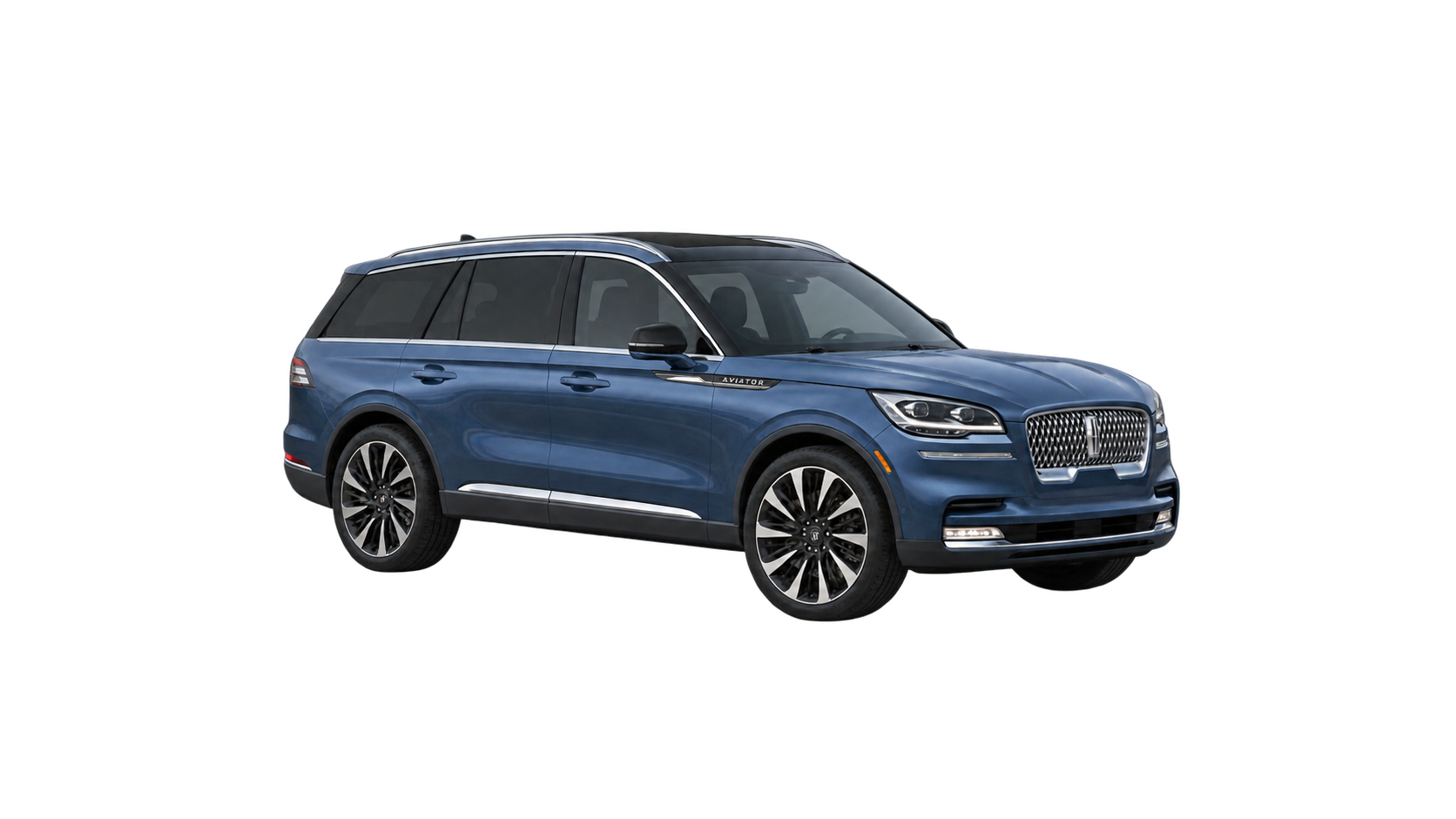
According to Au7o's research across NHTSA recalls, manufacturer TSBs, and owner forum reports, the 2021 Lincoln Aviator has 25 documented known issues, with 13 rated critical. The most serious are Front-Wiper Motor May Become Intermittent or Inoperative - Recall 26S14 / 26V117, Cell-Phone EMI Can Distort Rear-Camera Image - Recall 24S35 / 24V368, 3.0L EcoBoost Intake-Valve Fracture Recall 24S55 / NHTSA 24V635, PHEV P1A0C and Stop Safely Now After Remote-Start/Charge-Cord Sequence - CSP 22P16, Aviator Air Glide Suspension — Compressor and Bag Failures ($700-$2,500 repair), Recall 25V093: Loose Seat Belt Buckle and Anchor Bolts on 2020-2021 Aviator, Battery-Cable Harness Contact with A/C Pulley - Recall 21S34 / 21V534, High-Voltage Battery Cable Chafing on A/C Compressor Pulley (Fire Risk). at .
Ford Motor Company (Ford) is recalling certain 2020-2023 Lincoln Aviator and 2020-2022 Lincoln Corsair vehicles equipped with a Revel Audio System. When the driver's seat belt is not buckled and the vehicle is started, the seat belt warning system may activate the audible warning chime for an insufficient amount of time of less than 4 seconds. As such, these vehicles fail to comply with the requirements of Federal Motor Vehicle Safety Standard number 208, "Occupant Crash Protection."
Campaign #22V95300023/12/2022
BACK OVER PREVENTION: SENSING SYSTEM: CAMERA
Ford Motor Company (Ford) is recalling certain 2020-2023 Explorer, Lincoln Aviator, and 2020-2022 Lincoln Corsair vehicles equipped with a 360-degree camera. The video output may fail, preventing the rearview camera image from displaying.
Campaign #23V02200023/01/2023
EQUIPMENT:OTHER:LABELS
Ford Motor Company (Ford) is recalling certain 2020-2025 Explorer, Lincoln Aviator, 2020-2024 Escape, Lincoln Corsair, 2018-2024 F-150, Expedition and Lincoln Navigator vehicles. The air bag warning label may be missing from the dashboard. As such, these vehicles fail to comply with the requirement Federal Motor Vehicle Safety Standard number 208, "Occupant Crash Protection."
🔧
A mechanic who knows YOUR exact car
Answers tuned to your year, make, model & trim — not generic advice. Save your garage so it always has the right context.
Get ahead of Lincoln Aviator problems — free
Leave your email and we'll alert you the moment there's a new recall or known issue for your Lincoln Aviator. Free, no account needed.
What are the most common Lincoln Aviator problems?
According to Au7o's research across NHTSA recalls, manufacturer TSBs, and owner forum reports, the 2021 Lincoln Aviator has 25 documented issues. The most frequently reported are: Front-Wiper Motor May Become Intermittent or Inoperative - Recall 26S14 / 26V117, Cell-Phone EMI Can Distort Rear-Camera Image - Recall 24S35 / 24V368, 3.0L EcoBoost Intake-Valve Fracture Recall 24S55 / NHTSA 24V635. Of these, 13 are rated critical and should be addressed promptly.
Is the Lincoln Aviator reliable?
The 2021 Lincoln Aviator has 25 known issues compiled from NHTSA recalls, manufacturer TSBs, and owner forum reports. 13 issues are rated critical: Front-Wiper Motor May Become Intermittent or Inoperative - Recall 26S14 / 26V117 and Cell-Phone EMI Can Distort Rear-Camera Image - Recall 24S35 / 24V368 and 3.0L EcoBoost Intake-Valve Fracture Recall 24S55 / NHTSA 24V635 and PHEV P1A0C and Stop Safely Now After Remote-Start/Charge-Cord Sequence - CSP 22P16 and Aviator Air Glide Suspension — Compressor and Bag Failures and Recall 25V093: Loose Seat Belt Buckle and Anchor Bolts on 2020-2021 Aviator and Battery-Cable Harness Contact with A/C Pulley - Recall 21S34 / 21V534 and High-Voltage Battery Cable Chafing on A/C Compressor Pulley (Fire Risk) and Unexpected Acceleration and Phantom Braking With Driver-Assist (Co-Pilot360 / BlueCruise) Engaged and Aviator Transmission Safety Recalls: Park and Direction-Control Defects and Aviator Early-Build Recalls — Driveshaft Weld (NHTSA 20V-693), plus other 2020 actions and Rear-Camera Blue/Black Image - Recalls 23S23 / 23V342 and 25S27 / 25V159 and Owner-Reported Panoramic-Roof Glass Shattering - Inspection Required. Prospective buyers should inspect for these issues and factor potential repair costs into their purchase decision. Regular maintenance following the manufacturer's schedule helps prevent many common problems.
How much does it cost to fix common Lincoln Aviator problems?
Repair costs for known Lincoln Aviator issues range from $0 to $2,500, depending on the specific problem and whether you choose DIY or professional repair. Au7o provides step-by-step DIY maintenance guides that can help reduce repair costs.
What is the 2020-2022 Lincoln Aviator Front-Wiper Motor May Become Intermittent or Inoperative - Recall 26S14 / 26V117?
Content on this page was compiled with AI assistance using NHTSA complaints, TSBs, owner reports, and public automotive data. While we strive for accuracy, this information may contain errors. Always verify repair procedures and specifications with your vehicle's service manual or a qualified mechanic.
Filter:
On the 2020-2022 Lincoln Aviator, certain 2020-2022 Lincoln Aviators produced from July 6, 2020, through December 15, 2021, are included in Ford recall 26S14/NHTSA 26V117. A front-wiper motor cover terminal may be misaligned with the brush-card terminal, creating a poor electrical connection that can progress from intermittent operation to complete wiper inoperability. Reduced visibility can increase crash risk. Recall inclusion is determined by VIN, not model year alone.
Common Symptoms
Front wipers operate intermittently
Front wipers become completely inoperative
Recall notice or open VIN campaign
How to Fix
Check the VIN and schedule recall 26S14 with a Lincoln dealer if it is open. The dealer inspects the front-wiper motor and replaces it as needed at no charge. Do not purchase motor LC5Z-17508-F from this record; the recall inspection determines whether replacement is required. If the wipers stop during rain or snow, slow down, leave the roadway safely, and do not continue until visibility is adequate.
Owner tips & cautions
WarningAn intermittent wiper can become fully inoperative. Use the free VIN-specific campaign rather than ordering a motor before dealer inspection.
On the 2020-2024 Lincoln Aviator, certain 2020-2024 Lincoln Aviators are included in Ford recall 24S35/NHTSA 24V368. The APIM video circuit can be susceptible to 1.6-2.7 GHz electromagnetic interference from an in-use mobile phone placed near the console while the vehicle is in reverse. Ford testing found the worst case with a phone near the console cupholder, weak cellular signal, and an active call. The rearview image may flicker, jump, shake, or scroll, reducing rear visibility. Inclusion is determined by VIN.
Common Symptoms
Rearview image flickers
Rearview image jumps, shakes, or scrolls
Distortion occurs with an active phone near the console while reversing
How to Fix
Check the VIN and schedule recall 24S35 if open. A Ford/Lincoln dealer installs the specified electromagnetic shielding on the APIM at no charge; the campaign is not an APIM replacement. Until completed, follow Ford's advice to refrain from cell-phone use while reversing and rely on mirrors and direct observation if the image is distorted. This record intentionally has no commerce link.
Owner tips & cautions
WarningUntil 24S35 is completed, do not use a mobile phone while reversing; keep it away from the console and use mirrors and direct observation if the display distorts.
On the 2020-2021 Lincoln Aviator 3.0L EcoBoost V6 gasoline, certain 2020-2021 Lincoln Aviators with the 3.0-liter gasoline engine are included in Ford recall 21S34/NHTSA 21V534. An improperly secured battery-cable wire harness can contact the A/C compressor pulley. Continued rubbing may damage the harness insulation or drive belt and expose the unfused positive battery circuit, creating a short-circuit and fire risk. Inclusion is determined by VIN rather than model year alone.
Common Symptoms
Recall notice or open VIN campaign
Visible battery-cable harness contact or insulation damage near the A/C compressor pulley
Smoke, burning odor, or electrical short if damage progresses
How to Fix
Check the VIN and arrange the free recall remedy with a Lincoln dealer. The dealer installs a tie strap to keep the harness away from the A/C compressor pulley and inspects the harness for contact damage, repairing or replacing it as necessary. Do not purchase a generic harness, belt, or compressor part for the campaign. If smoke, burning odor, or an electrical short is present, stop safely, shut the vehicle down away from structures when possible, and contact emergency or Lincoln service assistance as appropriate.
Owner tips & cautions
WarningThis fire-risk campaign is free and VIN-specific; do not buy a harness or belt before the dealer performs the recall inspection.
On the 2020-2021 Lincoln Aviator, on 2020-2021 Lincoln Aviator models equipped with the 3.0L engine, the battery cable wiring harness may not be properly secured and can contact the air conditioner compressor pulley. Friction wears through the insulation, allowing the pulley to short the positive (B+) circuit, creating fire risk. NHTSA Campaign 21V534000 (Ford ref 21S34) covered approximately 36,258 vehicles. A separate 2025 recall (25S58 / NHTSA 23V626) addressed an unrelated HV battery cell defect on PHEV variants.
Common Symptoms
Burning smell from engine bay
Smoke from under hood
Engine compartment fire
A/C belt damage
How to Fix
Free recall fix under NHTSA 21V534000 - dealer inspects the harness and A/C compressor belt for damage, replaces them if needed, and installs a tie strap to secure the wire harness. Owners of 2020-2021 PHEV Aviators should separately check recall 25S58 (HV battery cell defect, unrelated to this cable issue).
On the 2020-2023 Lincoln Aviator, certain 2020-2023 Aviators are covered by Ford recall 23S23/NHTSA 23V342 for an intermittent rear-camera blue image or full blue/black SYNC screen in reverse or low-speed 360-degree view. Ford later opened recall 25S27/NHTSA 25V159 for specific vehicles recorded as successfully repaired under 23S23 even though the intended IPMB software was not installed. Because these populations are VIN-specific, a prior repair record does not replace a current VIN check.
Common Symptoms
Rear camera displays a blue image
SYNC screen becomes fully blue or black in reverse
360-degree view loses the camera image at low speed
Recall 25S27 opens after an earlier 23S23 repair
How to Fix
Check the VIN for both 23S23 and 25S27. The 23S23 Aviator repair includes rear-camera replacement, strain-relief wiring, 360-camera alignment, and an IPMB update when directed by Ford's service tool. The 25S27 remedy updates the IPMB and validates the installed software part number before closing the campaign, free of charge. Do not buy a camera or module from this card. Until repaired, use mirrors and direct observation whenever the image is unavailable.
Owner tips & cautions
WarningRecheck the VIN even if 23S23 shows a past repair; recall 25S27 covers specific vehicles whose intended software was not actually installed.
On the 2020-2022 Lincoln Aviator, ford SSM 50804 says some 2020-2022 Aviators with an activated modem may have 12-volt battery-drain symptoms when unaffiliated third-party phone applications repeatedly request vehicle commands such as lock, unlock, remote start, or location. Those calls can keep the vehicle network active. This is one documented cause, not proof that every dead battery is a TCU, latch, battery, or module failure. Ford separately explains that a Deep Sleep notification can be normal after 14 days, low voltage, state of charge below 50 percent, or a TCU update.
Common Symptoms
12-volt battery discharges while the vehicle is parked
No-start or low-voltage condition
Repeated modem activity associated with a third-party vehicle-control app
Deep Sleep notification requiring state-of-charge evaluation if it persists after charging
How to Fix
Identify and uninstall any non-Ford/Lincoln app that accesses the vehicle, then fully charge and test the 12-volt battery and monitor key-off draw and battery state of charge. If symptoms remain, follow normal Ford battery, battery-monitoring-sensor, charging-system, modem, and module network-sleep diagnostics. A Deep Sleep notification by itself is not a failed module; if state of charge does not change after charging or a BMS reset, continue the battery/BMS diagnostic path. Do not replace a latch, TCU, battery, or other module without a failed test, and do not present a maintainer as the repair for an unresolved drain.
Owner tips & cautions
TipRemove unaffiliated vehicle-control apps before a key-off draw test so repeated modem requests do not mask the remaining diagnosis.
WarningDo not replace a battery, latch, modem, or module from a dead-battery complaint alone; charge and test the battery and measure the key-off draw after the network has had time to sleep.
On the 2020-2023 Lincoln Aviator, some 2020-2023 Aviators may exhibit lack of audio after rainfall or a car wash together with water in the rear-liftgate area or spare-tire area. Ford TSB 23-2181 directs Aviator-specific inspection of the power-liftgate grommet, margin seal and pushpins, electrical-wiring grommet, rear washer hose, body-hole plugs, BLIS-module seating, and BLIS harness grommets. The bulletin calls for ACM replacement when right-side water is present; it does not establish water damage as the cause of every audio outage.
Right-side rear water evidence requiring ACM inspection
How to Fix
Confirm both the audio symptom and rear water evidence, then follow the Aviator inspection sequence in TSB 23-2181. Correct only the leak path found: reseat or replace the specified grommet/strut when required, seat seals and connectors, repair plugs or washer-hose routing, and verify the BLIS module and harness grommets. If right-side water is present, follow the bulletin's ACM replacement step and use the VIN-specific parts catalog application. Dry and inspect affected connectors and trim as directed. Coverage depends on the vehicle's applicable warranty or service plan; this record has no commerce link.
Owner tips & cautions
TipPhotograph the wet side and first water path before drying; TSB 23-2181 uses location-specific inspection and only conditionally replaces the ACM.
WarningDo not order an audio module from loss of sound alone; confirm water evidence, repair the leak path, and use the VIN-specific catalog application if replacement is required.
On the 2020-2021 Lincoln Aviator, ford Motor Company, which builds the Lincoln Aviator, issued safety recall 25V093000 covering certain 2020 and 2021 Aviator SUVs. On affected vehicles the seat belt buckle anchor bolts at one or more seating positions may not have been properly secured during assembly. Aviators built with a second-row center seating position may additionally have an improperly secured seat belt retractor anchor bolt and/or seat belt anchor bolt at that position. Because the hardware that ties the belt or buckle to the vehicle structure may be loose, a belt or buckle may not properly restrain an occupant in a crash, which raises the risk of injury. NHTSA lists the campaign as affecting 240,510 vehicles in total; that figure covers the entire recall campaign, not the Aviator alone.
Common Symptoms
A seat belt buckle that feels loose or moves at its mounting point
A seat belt anchor or retractor that feels loose at the second-row center seating position
How to Fix
The repair is free at any Lincoln dealer. The dealer inspects the seat belt buckle anchor bolts at every seating position, and on Aviators equipped with a second-row center seat also inspects that position's seat belt retractor anchor bolt and seat belt anchor bolt. If any of those anchor bolts are found loose, the affected seat components are replaced at no charge. Ford mailed owner notification letters on June 5, 2025; if you did not receive one or bought the Aviator used, enter your VIN at nhtsa.gov/recalls to confirm whether recall 25V093000 is still open on your vehicle, then contact Ford/Lincoln customer service or your dealer to schedule the inspection.
On the 2021-2025 Lincoln Aviator, owners across multiple model years report two opposite but related ADAS misbehaviors. With adaptive cruise / driver-assist (Co-Pilot360, ActiveGlide/BlueCruise) engaged, the Aviator has unexpectedly ACCELERATED toward a stopped vehicle instead of continuing to slow, and separately has applied PHANTOM BRAKING — abrupt, unprompted automatic braking triggered by harmless objects such as a crack in the driveway, overpass shadows, or roadside features. Some events come with 'Antilock brake fault' or 'Pre-Collision Assist not available' messages. These are hard to reproduce on demand and are documented in NHTSA complaints and owner forums; no broad recall specifically targets this behavior.
Vehicle accelerates toward a stopped car while adaptive cruise/driver-assist is on
Sudden hard automatic braking for no real obstacle (phantom braking)
Abrupt stops triggered by pavement cracks, shadows, or overpasses
'Pre-Collision Assist not available' or 'Antilock brake fault' messages
Driver-assist disengages unexpectedly during the event
How to Fix
Report any unexpected-acceleration or phantom-braking event to NHTSA (vehicle safety hotline / nhtsa.gov) and to the dealer, with date/time so the module can be scanned for stored events. Ensure all camera/radar sensors are clean, undamaged, and properly aimed (especially after any windshield or bumper work, which requires ADAS recalibration), and that the IPMA/ADAS modules are on the latest software (see related camera/IPMA recalls). Until resolved, use driver-assist features cautiously and keep ready to override with throttle/brake; treat repeated events as a safety concern warranting dealer investigation.
On the 2020-2021 Lincoln Aviator, 2020 Aviator launches were affected by several recalls. Most serious: NHTSA 20V-693 (Ford 20S65) covering 2020 Aviator and Explorer with 2.0L or 3.3L engines plus 10-speed automatic AWD — the rear driveshaft may not have been welded properly, can fracture along the weld seam causing loss of drive, vehicle rollaway in Park, or impact with the fuel tank. A separate set of stop-sale actions in 2019-2020 covered second-row seat-back recliner welds, brake hose pinch, and battery fasteners. Many early owners experienced multiple dealer visits in the first year.
Common Symptoms
driveline vibration
driveshaft separation
recall notice in mail
How to Fix
Check VIN against NHTSA recalls lookup — multiple campaigns may apply (20V-693 most serious). All remedies are free under recall. Dealer inspects the rear driveshaft and replaces if necessary. Request a full recall history printout from a Lincoln dealer if you own a 2020 Aviator and have had no recall service.
On the 2020-2025 Lincoln Aviator, nHTSA complaint records and Aviator owner discussions include reports of panoramic-roof glass shattering while driving. A complaint documents an alleged event; it does not by itself prove a common manufacturing defect or cause. Impact damage, edge damage, installation stress, thermal stress, body movement, or an unknown cause require physical inspection. No Aviator-specific panoramic-roof glass recall was identified in this audit.
Common Symptoms
Sudden loud breakage sound from the panoramic roof
Panoramic-roof glass fragments or cracking
No obvious impact identified by the owner before inspection
How to Fix
If glass breaks, maintain control, avoid abrupt steering, move to a safe location, protect occupants from loose fragments, and arrange recovery if visibility or occupant safety is compromised. Preserve photos of both glass surfaces, edges, the opening, nearby paint, weather, speed, and road conditions before cleanup. Have a qualified glass/body specialist inspect for an impact origin and installation or frame evidence. Report an unexplained safety event to NHTSA and Lincoln. Coverage and repair scope must be determined case by case; this record has no commerce link.
Owner tips & cautions
TipPhotograph the break pattern, both glass surfaces, edges, roof opening, and surrounding paint before cleanup so an impact origin or installation evidence can be assessed.
WarningDo not assume spontaneous breakage or impact from appearance alone; preserve evidence and obtain a qualified inspection before making a defect or coverage claim.
On the 2020-2024 Lincoln Aviator, 2020+ Aviators with the panoramic moonroof are widely reported to leak after heavy rain or carwashes when the rear sunroof drain lines clog with debris. Water tracks down the A-pillars or C-pillars, soaks the headliner, drips onto third-row seats or visors, and can enter interior light controls causing flickering or unresponsive switches. Multiple forum threads document the problem and dealer warranty drain-cleaning service.
Common Symptoms
Water dripping above sun visors
Wet headliner around panoramic roof
Water on third-row seats after rain
Musty smell from headliner
Interior dome light malfunctions after rain
How to Fix
Have dealer flush all four sunroof drain tubes with compressed air (covered under bumper-to-bumper warranty if within 4yr/50k). Owners can preventively blow out drains annually with a soft air line. If headliner is soaked, mold remediation may be required.
On the 2020-2023 Lincoln Aviator, owners of 2020-2023 Aviators have reported water or dampness near the panoramic roof, headliner, pillars, or rear seating area after rain. These observations do not identify one universal cause. A clogged, kinked, disconnected, or damaged drain; glass or seal fit; roof opening; body seam; or a separate rear-liftgate leak can produce overlapping evidence. Ford TSB 23-2181 covers rear liftgate/spare-tire paths, not a universal sunroof-drain repair.
Common Symptoms
Water or dampness at the headliner or roof opening
Water tracks at a pillar
Wet rear seat, trim, carpet, or cargo area after rain
Musty odor or staining after water entry
How to Fix
Document the entry location before drying or disassembly, then have the vehicle water-tested in controlled sections so the first wet point can be traced. Inspect panoramic-roof drains and connections, glass/seal fit, roof and body seams, and the rear liftgate/spare-tire paths as indicated by the evidence. Do not use compressed air blindly because excessive pressure can disconnect or damage a drain. Select cleaning, reconnection, adjustment, sealing, or component repair only after the leak path is confirmed. This record intentionally has no commerce link.
Owner tips & cautions
TipPhotograph the first wet point and the conditions that reproduce it before the interior is dried; leak-path evidence is more useful than the location where water finally drips.
WarningDo not force high-pressure air through an unverified drain path; a disconnected or damaged hose can turn an intermittent leak into a larger one.
On the 2020-2022 Lincoln Aviator, ford documents several distinct Aviator power-liftgate conditions. On some 2020-2022 vehicles, failure only through hands-free intelligent access or the outside handle while doors are locked can result from a poor connection at rear-keyless-entry connector C4332 below the striker (SSM 50810). Some 2020-2021 inoperative liftgates can involve RGTM software (SSM 49914). Early 2020 vehicles built on or before February 17, 2020, can partially open or trigger a false anti-theft alarm with B144D, B144E, B1555, or B1556 from RGTM software (SSM 49015). These bulletins do not diagnose every liftgate fault.
Common Symptoms
Hands-free or outside-handle opening fails while doors are locked
Power liftgate is inoperative
Early-build liftgate opens only partially
False anti-theft alarm with liftgate-ajar sensing
How to Fix
Record which inputs fail, door-lock state, build date, movement, latch behavior, warnings, and RGTM DTCs. For the SSM 50810 symptom, inspect connector C4332 for connection, terminal, and pin-fit problems. For a matching SSM 49914 or 49015 software condition, use the latest Ford diagnostic software to reprogram the RGTM. If the symptom does not match, continue Workshop Manual diagnosis of power, grounds, switches, latch, position sensing, struts, wiring, and obstruction detection before selecting a part. This record intentionally has no commerce link.
Owner tips & cautions
TipTest each input with the doors locked and unlocked and save the RGTM scan; input-specific behavior separates connector, software, and mechanical paths.
WarningDo not buy a latch, strut, motor, or RGTM from a generic no-open symptom; Ford's SSMs first require a specific symptom/build/DTC match.
On the 2020-2024 Lincoln Aviator, 2020+ Aviator with the optional Air Glide suspension shares its compressor and air spring design with the related Ford Explorer ST/Platinum. Owners report compressor noise becoming progressively louder by 40,000-80,000 miles, then bag leaks (rear first), then compressor burnout. Warning message: "Service Air Suspension."
Diagnose with FORScan to confirm air bag vs. compressor failure. OEM bags $700-$1,100 per corner installed. Compressor (Wabco/Continental unit) ~$600-$900 installed. Replace compressor dryer at the same time as a bag (~$80) — extends compressor life.
What you need to fix it
Only diagnosis- and fitment-reviewed repair parts are linked here.
LC5Z-5A891-Q genuine Ford rear air spring, driver side, gas 3.0L
OEMLC5Z-5A891-Q
Replace a leak-confirmed left/driver rear spring on a non-PHEV Air Glide Aviator Fitment/availability: Live Add to Cart page identifies driver side, replaces LC5Z-5A891-K and lists 2020-2025 Aviator 3.0L gas fitment. Confirm VIN, Air Gli…
LC5Z-5A891-R genuine Ford rear air spring, passenger side, gas 3.0L
OEMLC5Z-5A891-R
Replace a leak-confirmed right/passenger rear spring on a non-PHEV Air Glide Aviator Fitment/availability: Live Add to Cart page identifies passenger side, replaces LC5Z-5A891-J and lists 2020-2025 Aviator 3.0L gas fitment. Confirm VIN, …
LC5Z-5A891-N genuine Lincoln rear air spring, driver side, 3.0L PHEV
OEMLC5Z-5A891-N
Replace a leak-confirmed left/driver rear spring on an Air Glide Grand Touring PHEV Fitment/availability: Live Add to Cart page identifies driver side, replaces LC5Z-5A891-M/-E and lists 2020-2023 Aviator 3.0L PHEV fitment. Do not substi…
LC5Z-5A891-P genuine Ford rear air spring, passenger side, 3.0L PHEV
OEMLC5Z-5A891-P
Replace a leak-confirmed right/passenger rear spring on an Air Glide Grand Touring PHEV Fitment/availability: Live Add to Cart page identifies passenger side, replaces LC5Z-5A891-L/-G and lists 2020-2023 Aviator 3.0L PHEV fitment. Do not…
LC5Z-5319-C genuine Ford air-suspension compressor/leveling assembly
OEMLC5Z-5319-C
Replace a compressor that fails electrical, command, pressure, run-time or thermal diagnosis after leaks are repaired Fitment/availability: Live official Ford direct product page identifies SKU LC5Z5319C and the four-corner air-suspensio…
On the 2020-2023 Lincoln Aviator, some 2020-2023 Aviators equipped with air suspension may display a Drive Malfunction and/or Suspension Fault message with DTCs B1041 and U2100 stored in Suspension Control Module A (SUMA). Ford SSM 51621 says this bulletin-defined condition can occur when SUMA enters diagnostic service mode after an on-demand self-test following suspension diagnosis or repair. It does not identify a leaking air spring, compressor, height sensor, or solenoid as the cause of these two codes.
Common Symptoms
Drive Malfunction message
Suspension Fault message
DTC B1041 stored in SUMA
DTC U2100 stored in SUMA
How to Fix
Use Ford Diagnosis and Repair System (FDRS) and select SUMA > Run All CM (Continuous Memory) DTCs. Do not run SUMA > OD and CM DTCs for this condition because the on-demand self-test can create the invalid codes. If that test was run, clear the condition with SUMA > Transport and Factory Mode Deactivation. If other DTCs or physical ride-height symptoms remain, follow Workshop Manual Section 204-05 normal diagnostics before selecting a part. This record intentionally has no commerce link.
Owner tips & cautions
WarningDo not replace a compressor, air spring, sensor, or solenoid from B1041/U2100 alone; SSM 51621 first corrects a diagnostic service-mode state.
TipAsk whether an on-demand SUMA self-test was run immediately before the warning appeared and retain the complete FDRS fault report for any remaining diagnosis.
On the 2020-2022 Lincoln Aviator, a speed-related hum, growl, grind, vibration, or wheel-end play can be consistent with a wheel bearing, but tire tread, wheel damage, brakes, axle or CV joints, driveline components, and other rotating parts can sound similar. The reviewed evidence does not establish a Lincoln Aviator-wide premature front-hub defect or a reliable failure mileage. A bearing diagnosis must identify the corner and drivetrain configuration before any hub is selected.
Speed-related hum, growl, or grind from a front corner
Noise changes with steering load
Wheel-end play or roughness confirmed during inspection
How to Fix
Road-test while documenting speed, steering load, road surface, braking, and acceleration effects. Inspect tires and wheels, brakes, axle/CV joints, and wheel-end play; use chassis ears or other NVH tools when needed to isolate the corner. Confirm the exact VIN, RWD/AWD configuration, axle position, side, sensor configuration, and current Ford supersession in the parts catalog before ordering a hub. Do not infer C0050 or C0040 without a scan. This record intentionally has no commerce link until diagnosis and VIN-specific fitment are known.
Owner tips & cautions
TipAsk the technician to document the isolated corner and the NVH evidence, then verify RWD/AWD and current VIN-specific hub supersession before ordering.
WarningNoise that changes in a weave can suggest a wheel end but is not conclusive; tires, brakes, and driveline sources must be excluded.
On the 2020-2022 Lincoln Aviator 3.0L EcoBoost PHEV (Grand Touring), certain 2020-2022 Aviator PHEVs are included in Ford Customer Satisfaction Program 22P16. Ford states that if remote start is requested while the vehicle is connected to a charging cable, the cable is disconnected, and the vehicle is then driven, the engine may not start when needed. The vehicle remains limited to high-voltage battery power; when that battery is depleted, DTC P1A0C and Stop Safely Now can occur. Other loss-of-power or Stop Safely Now events require separate diagnosis.
Common Symptoms
Engine does not start after remote start while plugged in and subsequent cord disconnection
Vehicle operates only on high-voltage battery until depletion
Stop Safely Now message
DTC P1A0C
How to Fix
Have a Lincoln dealer check the VIN in OASIS for CSP 22P16. For an included vehicle, the dealer updates the PCM, ABS module, secondary on-board diagnostic modules, and battery energy control module to the latest levels at no charge within the program terms. If P1A0C or Stop Safely Now occurs after a different sequence, retain a full vehicle scan and diagnose that event independently rather than assuming 22P16. The program document states coverage through 8 years/100,000 miles from warranty start for affected VINs.
Owner tips & cautions
TipPreserve the full scan and the exact remote-start, charging-cable, and drive sequence; P1A0C after the CSP-defined sequence is much more specific than Stop Safely Now by itself.
WarningDo not treat every PHEV loss-of-power event as CSP 22P16; other high-voltage, charging, or powertrain faults need their own diagnosis.
On the 2020-2022 Lincoln Aviator, ford SSM 50435 says some 2020-2022 Aviator vehicles may exhibit driveline vibration and that Workshop Manual Section 205-01 Pinpoint Tests G (driveline shudder) and H (driveline vibration) were updated. The bulletin does not identify one speed, one failed component, or an automatic driveshaft replacement. Tires, wheels, driveline order, shafts, joints, mounts, axle components, or other rotating parts must be isolated through the prescribed tests. This diagnostic condition is separate from recall 20S65's VIN-specific weld-seam defect.
Common Symptoms
Driveline vibration
Driveline shudder
Speed- or load-dependent vibration requiring NVH isolation
How to Fix
Record vehicle speed, engine speed, gear, load, and whether the vibration is felt through the seat, floor, or steering. Have a qualified technician use Ford WSM Section 205-01 Pinpoint Tests G and H and appropriate NVH measurements to identify the vibration order and source before selecting a component. Also check the VIN for recall 20S65, but do not assume the recall or replace the rear driveshaft from vibration alone. This record intentionally has no commerce link.
Owner tips & cautions
TipRecord the exact speed, gear, load, and where the vibration is felt; those details help distinguish tire/wheel, shaft, and driveline-order sources.
WarningDo not approve a rear driveshaft from a road-speed vibration alone; require the updated Ford WSM pinpoint-test result and check recall 20S65 separately by VIN.
On the 2020-2025 Lincoln Aviator, three separate VIN-scoped transmission recalls affect limited Aviator populations. NHTSA 26V402 covers certain 2020-2021 vehicles whose separator-plate design can restrict flow to the park valve, allow temporary park-pawl engagement while moving, damage the park system, and create a later rollaway risk. NHTSA 23V070/Ford 23S06 covers certain 2023 Aviators whose transmission may contain a loose extra bolt that can block the park pawl even when the selector shows Park. NHTSA 25V164/Ford 25S19 covers specified 2025 Aviators built December 4-20, 2024, whose main-control valve body may cause no reverse or unexpected forward motion in Reverse or Neutral. These campaigns are not interchangeable and do not cover every listed model year.
Common Symptoms
Vehicle movement after Park when the park system has been damaged on a 26V402-covered vehicle
Selector shows Park but the park pawl does not engage on a 23V070-covered vehicle
No reverse motion on a 25V164-covered vehicle
Unexpected forward motion with Reverse or Neutral selected on a 25V164-covered vehicle
Malfunction indicator and wrench warning for the 25V164 condition
How to Fix
Check the VIN in the NHTSA and Lincoln/Ford recall systems and follow the instructions for the campaign actually open. For 26V402, follow the current do-not-drive advisory and contact a Lincoln dealer for transport guidance; the free remedy is updated PCM software plus inspection and replacement of damaged park-system components as needed. For 23S06, the dealer inspects for the loose bolt and replaces the transmission if the inspection fails. For 25S19, the dealer replaces the transmission main-control valve body. Do not buy transmission parts or combine a harsh-shift complaint with these recall remedies without VIN confirmation.
Owner tips & cautions
WarningIf the VIN is included in recall 26V402, follow the current do-not-drive instruction and contact Lincoln for safe transport rather than driving to the dealer.
TipAsk the dealer to identify the exact campaign number before service; the 2020-2021, 2023, and 2025 transmission recalls have different defects and remedies.
On the 2020-2023 Lincoln Aviator, some 2020-2023 Lincoln Aviators equipped with a 10R60 and built on or before December 23, 2022, or a 10R80 MHT and built on or before August 15, 2022, may have harsh or delayed engagement and/or harsh or delayed shifts. Ford TSB 22-2428 says the condition may involve PCM/TCM software, the transmission solenoid-ID strategy, sticking main-control valves, or axial movement of the CDF clutch-cylinder sleeve. The complaint may occur with or without a malfunction indicator and the bulletin's listed transmission DTCs. The symptom alone does not select a valve body, CDF cylinder, or complete transmission.
Malfunction indicator with a bulletin-listed transmission DTC
How to Fix
Have a Ford/Lincoln-capable technician confirm the transmission and build date, retrieve PCM/TCM faults, and follow TSB 22-2428 in order. The bulletin begins with available PCM/TCM programming and an adaptive-learning drive cycle, then uses the stored faults and clutch behavior to select an accelerated main-control break-in routine. If the condition remains, the procedure can require main-control overhaul and, only after the bulletin's later tests fail, condition-specific internal transmission repair. Parts and coverage must be selected by VIN and the actual failed step; this record intentionally has no buy link.
Owner tips & cautions
TipRecord the exact shift or engagement event and ask for the PCM/TCM fault report plus the TSB decision-tree step that failed before approving internal transmission work.
WarningDo not order a valve body or CDF part from harsh shifting alone; Ford's procedure can resolve the condition through programming, adaptive learning, or clutch cycling before parts are selected.
On the 2021-2022 Lincoln Aviator 3.0L Nano EcoBoost V6, certain 2021-2022 Lincoln Aviators with 3.0-liter Nano EcoBoost engines are included in Ford recall 24S55/NHTSA 24V635. Intake valves produced outside the intended hardness specification can fracture while driving, causing engine failure and loss of drive power. Ford's later customer-satisfaction program identifies Aviator engine/build ranges from June through October 2021 and provides additional long-block coverage after the recall inspection. Inclusion is VIN-specific; the 2.7-liter engine named in the multi-model recall does not describe an Aviator powertrain.
Sudden loss of drive power if an intake valve fractures
Engine failure
Severe rough running or misfire if the failure occurs
How to Fix
Check the VIN and have a Ford/Lincoln dealer complete recall 24S55. The free recall remedy is an engine-cycle inspection test; the dealer replaces the engine only when the procedure determines replacement is necessary. Vehicles that completed the inspection process may qualify for the no-cost, one-time long-block program under CSP 24N12 for 10 years or 150,000 miles from warranty start, subject to its terms. Do not buy a long block or internal-engine parts for this recall. If the engine loses power or develops a severe running problem, move out of traffic safely and contact Lincoln for service guidance.
Owner tips & cautions
WarningThis is a free VIN-specific recall inspection. Do not order an engine or internal parts from a generic 24S55 listing.
TipAsk the dealer to document completion of the 24S55 inspection because CSP 24N12 coverage depends on that inspection process and its program terms.
On the 2020-2025 Lincoln Aviator, ford recall 25S66/NHTSA 25V407 covers certain 2020-2025 Lincoln Aviators produced from October 19, 2018, through May 30, 2025. Insufficient adhesive bonding can allow a C-pillar trim applique or rear-door window division bar to detach while driving, creating a road hazard. Not every vehicle in the model-year range is included, so recall status must be checked by VIN.
Common Symptoms
C-pillar trim applique lifts or loosens
Rear-door window division bar loosens
Trim flaps or detaches while driving
Recall notice or open VIN campaign
How to Fix
Check the VIN and schedule the free Lincoln recall remedy if 25S66 is open. The dealer repairs or replaces the affected C-pillar appliques and rear-door window division bars. Do not use generic adhesive or purchase trim from this record; the campaign determines the approved preparation, repair, and replacement path. If trim is already loose, avoid manipulating it and ask the dealer for safe interim handling guidance.
Owner tips & cautions
WarningDo not glue or order trim from a generic listing before VIN confirmation; the recall repair or replacement is performed free by the dealer.
On the 2020-2021 Lincoln Aviator 3.0L EcoBoost PHEV (Grand Touring), some 2020-2021 Aviator hybrid vehicles may exhibit brake-pedal pulsation or vibration when the brakes are applied. The driver may describe the ABS activating even though no ABS indicator appears in the instrument cluster. Ford TSB 21-2293 attributes this bulletin-defined condition to regenerative-braking software in the ABS module. The bulletin does not say that every brake pulsation is software-related or rule out rotor, tire, wheel, hydraulic, or mechanical causes without diagnosis.
Common Symptoms
Brake-pedal pulsation or vibration while braking
ABS-like pedal feedback without an ABS indicator
How to Fix
Have a Ford/Lincoln technician first confirm that the vehicle is a 2020-2021 Aviator hybrid matching TSB 21-2293 and that the symptom fits the bulletin. The TSB procedure is a coordinated flash: reprogram the PCM with the latest diagnostic-tool software, which also reprograms the ABS module. If pulsation remains or does not match the described condition, continue normal brake-system diagnosis rather than assuming warped rotors or replacing parts from this record.
Owner tips & cautions
TipAsk the technician to document whether the symptom matches TSB 21-2293 before module programming and to continue normal brake diagnosis if it does not.
WarningA software bulletin does not prove that all pedal pulsation is harmless; abnormal braking performance still requires prompt inspection.
On the 2020-2023 Lincoln Aviator, some 2020-2023 Aviators built on or before March 20, 2023, may exhibit a passenger-door window-control switch-to-bezel rattle while audio plays through the speakers. Ford SSM 51539 says the switch and bezel can resonate at their natural frequencies and the noise may be misdiagnosed as a speaker problem. This record does not cover unrelated dash, console, pillar, seat, sunroof, or road-input rattles.
Common Symptoms
Passenger-door rattle while audio plays
Rattle isolated with the 100 Hz passenger-front speaker test
Noise that may be mistaken for a passenger-front speaker fault
How to Fix
Follow Ford Workshop Manual Section 415-00 Pinpoint Test E1. Use its 100 Hz speaker test sample and set fade/balance to the passenger-front speaker. If the rattle is isolated to the passenger-door switch bezel, remove the bezel per WSM 501-11, apply Rotunda flock tape 164-R4903 in the SSM's U-shaped placement over the underside of the bezel and switch, reassemble, and rerun Pinpoint Test E1. If the noise remains, continue the remaining Pinpoint Test E steps before selecting another component.
What you need to fix it
Only diagnosis- and fitment-reviewed repair parts are linked here.
Apply the exact Ford-specified anti-rattle material after the passenger-front switch bezel is isolated Fitment/availability: Live direct product page identifies 164-R4903 Flock Tape (Fuzzy) Strips, 24-pack, supplied by Helm Consumables, …
Ford Motor Company (Ford) is recalling certain 2020-2023 Explorer, Lincoln Aviator, and 2020-2022 Lincoln Corsair vehicles equipped with a 360-degree camera. The video output may fail, preventing the rearview camera image from displaying.
Campaign #23V34200012/05/2023
POWER TRAIN:AUTOMATIC TRANSMISSION
Ford Motor Company (Ford) is recalling certain 2022-2023 F-150, Mustang, Explorer, Bronco, and 2023 Lincoln Aviator vehicles equipped with automatic transmissions. The transmission may contain a loose bolt which could prevent the transmission from engaging the park gear, although the gear shifter position may indicate that the vehicle has been shifted to "PARK."
Certain 2020-2022 Lincoln Aviators produced from July 6, 2020, through December 15, 2021, are included in Ford recall 26S14/NHTSA 26V117. A front-wiper motor cover terminal may be misaligned with the brush-card terminal, creating a poor electrical connection that can progress fro… Severity: high.
What is the 2020-2024 Lincoln Aviator Cell-Phone EMI Can Distort Rear-Camera Image - Recall 24S35 / 24V368?
Certain 2020-2024 Lincoln Aviators are included in Ford recall 24S35/NHTSA 24V368. The APIM video circuit can be susceptible to 1.6-2.7 GHz electromagnetic interference from an in-use mobile phone placed near the console while the vehicle is in reverse. Ford testing found the wor… Severity: high.
What is the 2021-2022 Lincoln Aviator 3.0L EcoBoost Intake-Valve Fracture Recall 24S55 / NHTSA 24V635?
Certain 2021-2022 Lincoln Aviators with 3.0-liter Nano EcoBoost engines are included in Ford recall 24S55/NHTSA 24V635. Intake valves produced outside the intended hardness specification can fracture while driving, causing engine failure and loss of drive power. Ford's later cust… Severity: high.
What is the 2020-2022 Lincoln Aviator PHEV P1A0C and Stop Safely Now After Remote-Start/Charge-Cord Sequence - CSP 22P16?
Certain 2020-2022 Aviator PHEVs are included in Ford Customer Satisfaction Program 22P16. Ford states that if remote start is requested while the vehicle is connected to a charging cable, the cable is disconnected, and the vehicle is then driven, the engine may not start when nee… Severity: high.
What is the 2020-2024 Lincoln Aviator Aviator Air Glide Suspension — Compressor and Bag Failures?
2020+ Aviator with the optional Air Glide suspension shares its compressor and air spring design with the related Ford Explorer ST/Platinum. Owners report compressor noise becoming progressively louder by 40,000-80,000 miles, then bag leaks (rear first), then compressor burnout. Repairs typically run $700-$2,500. Severity: high.
What is the 2020-2021 Lincoln Aviator Recall 25V093: Loose Seat Belt Buckle and Anchor Bolts on 2020-2021 Aviator?
Ford Motor Company, which builds the Lincoln Aviator, issued safety recall 25V093000 covering certain 2020 and 2021 Aviator SUVs. On affected vehicles the seat belt buckle anchor bolts at one or more seating positions may not have been properly secured during assembly. Aviators b… Severity: high.
What is the 2020-2021 Lincoln Aviator Battery-Cable Harness Contact with A/C Pulley - Recall 21S34 / 21V534?
Certain 2020-2021 Lincoln Aviators with the 3.0-liter gasoline engine are included in Ford recall 21S34/NHTSA 21V534. An improperly secured battery-cable wire harness can contact the A/C compressor pulley. Continued rubbing may damage the harness insulation or drive belt and expo… Severity: high.
What is the 2020-2021 Lincoln Aviator High-Voltage Battery Cable Chafing on A/C Compressor Pulley (Fire Risk)?
On 2020-2021 Lincoln Aviator models equipped with the 3.0L engine, the battery cable wiring harness may not be properly secured and can contact the air conditioner compressor pulley. Friction wears through the insulation, allowing the pulley to short the positive (B+) circuit, cr… Repairs typically run $0-$0. Severity: high.
What is the 2021-2025 Lincoln Aviator Unexpected Acceleration and Phantom Braking With Driver-Assist (Co-Pilot360 / BlueCruise) Engaged?
Owners across multiple model years report two opposite but related ADAS misbehaviors. With adaptive cruise / driver-assist (Co-Pilot360, ActiveGlide/BlueCruise) engaged, the Aviator has unexpectedly ACCELERATED toward a stopped vehicle instead of continuing to slow, and separatel… Repairs typically run $0-$500. Severity: high.
What is the 2020-2025 Lincoln Aviator Aviator Transmission Safety Recalls: Park and Direction-Control Defects?
Three separate VIN-scoped transmission recalls affect limited Aviator populations. NHTSA 26V402 covers certain 2020-2021 vehicles whose separator-plate design can restrict flow to the park valve, allow temporary park-pawl engagement while moving, damage the park system, and creat… Severity: high.
What is the 2020-2021 Lincoln Aviator Aviator Early-Build Recalls — Driveshaft Weld (NHTSA 20V-693), plus other 2020 actions?
2020 Aviator launches were affected by several recalls. Most serious: NHTSA 20V-693 (Ford 20S65) covering 2020 Aviator and Explorer with 2.0L or 3.3L engines plus 10-speed automatic AWD — the rear driveshaft may not have been welded properly, can fracture along the weld seam caus… Repairs typically run $0-$0. Severity: high.
What is the 2020-2023 Lincoln Aviator Rear-Camera Blue/Black Image - Recalls 23S23 / 23V342 and 25S27 / 25V159?
Certain 2020-2023 Aviators are covered by Ford recall 23S23/NHTSA 23V342 for an intermittent rear-camera blue image or full blue/black SYNC screen in reverse or low-speed 360-degree view. Ford later opened recall 25S27/NHTSA 25V159 for specific vehicles recorded as successfully r… Severity: high.
What is the 2020-2025 Lincoln Aviator Owner-Reported Panoramic-Roof Glass Shattering - Inspection Required?
NHTSA complaint records and Aviator owner discussions include reports of panoramic-roof glass shattering while driving. A complaint documents an alleged event; it does not by itself prove a common manufacturing defect or cause. Impact damage, edge damage, installation stress, the… Severity: high.
What is the 2020-2023 Lincoln Aviator Air-Suspension Fault B1041/U2100 After SUMA Diagnostic Service Mode?
Some 2020-2023 Aviators equipped with air suspension may display a Drive Malfunction and/or Suspension Fault message with DTCs B1041 and U2100 stored in Suspension Control Module A (SUMA). Ford SSM 51621 says this bulletin-defined condition can occur when SUMA enters diagnostic s… Severity: medium.
What is the 2020-2025 Lincoln Aviator C-Pillar Trim and Rear-Door Window Bars May Detach - Recall 25S66 / 25V407?
Ford recall 25S66/NHTSA 25V407 covers certain 2020-2025 Lincoln Aviators produced from October 19, 2018, through May 30, 2025. Insufficient adhesive bonding can allow a C-pillar trim applique or rear-door window division bar to detach while driving, creating a road hazard. Not ev… Severity: medium.
What is the 2020-2021 Lincoln Aviator Hybrid Brake-Pedal Pulsation from ABS Regenerative-Braking Software - TSB 21-2293?
Some 2020-2021 Aviator hybrid vehicles may exhibit brake-pedal pulsation or vibration when the brakes are applied. The driver may describe the ABS activating even though no ABS indicator appears in the instrument cluster. Ford TSB 21-2293 attributes this bulletin-defined conditio… Severity: medium.
What is the 2020-2022 Lincoln Aviator Driveline Vibration: Diagnose with WSM Pinpoint Tests G and H?
Ford SSM 50435 says some 2020-2022 Aviator vehicles may exhibit driveline vibration and that Workshop Manual Section 205-01 Pinpoint Tests G (driveline shudder) and H (driveline vibration) were updated. The bulletin does not identify one speed, one failed component, or an automat… Severity: medium.
What is the 2020-2023 Lincoln Aviator 10R60/10R80 MHT Harsh or Delayed Engagement and Shifts (TSB 22-2428)?
Some 2020-2023 Lincoln Aviators equipped with a 10R60 and built on or before December 23, 2022, or a 10R80 MHT and built on or before August 15, 2022, may have harsh or delayed engagement and/or harsh or delayed shifts. Ford TSB 22-2428 says the condition may involve PCM/TCM soft… Severity: medium.
What is the 2020-2022 Lincoln Aviator 12-Volt Battery Drain from Third-Party App Modem Activity?
Ford SSM 50804 says some 2020-2022 Aviators with an activated modem may have 12-volt battery-drain symptoms when unaffiliated third-party phone applications repeatedly request vehicle commands such as lock, unlock, remote start, or location. Those calls can keep the vehicle netwo… Severity: medium.
What is the 2020-2024 Lincoln Aviator Panoramic Sunroof Drain Clog Causing Headliner/Interior Water Damage?
2020+ Aviators with the panoramic moonroof are widely reported to leak after heavy rain or carwashes when the rear sunroof drain lines clog with debris. Water tracks down the A-pillars or C-pillars, soaks the headliner, drips onto third-row seats or visors, and can enter interior… Repairs typically run $150-$1,200. Severity: medium.